Natural vs. Lab-Grown Rubies: The Complete Guide to Making the Right Choice
Few gemstones capture the human imagination quite like the ruby. Known historically as the "king of precious stones," its vibrant crimson hue symbolizes passion, power, and timeless elegance. Modern jewelry buyers face a fascinating choice between rubies formed deep within the Earth and those grown in technologically advanced laboratories. This guide clarifies the differences, uncovers the science, and helps you determine which ruby aligns best with your personal style, values, and budget.


Understanding the Shared DNA: Chemical and Physical Properties
The most critical fact to understand is that lab-grown rubies are real rubies. They are not imitations like cubic zirconia or red glass. Both varieties consist of the exact same mineral family: corundum. When aluminum oxide crystallizes under intense conditions, it forms corundum. The addition of trace amounts of chromium introduces that legendary fiery red color. Because their atomic blueprint is identical, they share the exact same technical specifications. Ranking 9 on the Mohs scale, rubies are second only to diamonds in hardness. This characteristic guarantees that whether your gemstone was mined or created in a lab, it possesses the durability required to become a cherished heirloom passed down through generations.
Understanding the Shared DNA: Chemical and Physical Properties
The most critical fact to understand is that lab-grown rubies are real rubies. They are not imitations like cubic zirconia or red glass. Both varieties consist of the exact same mineral family: corundum. When aluminum oxide crystallizes under intense conditions, it forms corundum. The addition of trace amounts of chromium introduces that legendary fiery red color. Because their atomic blueprint is identical, they share the exact same technical specifications. Ranking 9 on the Mohs scale, rubies are second only to diamonds in hardness. This characteristic guarantees that whether your gemstone was mined or created in a lab, it possesses the durability required to become a cherished heirloom passed down through generations.
Property
Property
Natural Rubies
Natural Rubies
Lab-Grown Rubies
Lab-Grown Rubies
Chemical Composition
Chemical Composition
Al₂O₃ (Aluminum Oxide with Chromium)
Al₂O₃ (Aluminum Oxide with Chromium)
Al₂O₃ (Aluminum Oxide with Chromium)
Al₂O₃ (Aluminum Oxide with Chromium)
Mohs Hardness Scale
Mohs Hardness Scale
9
9
9
9
Refractive Index
Refractive Index
1.762 to 1.770
1.762 to 1.770
1.762 to 1.770
1.762 to 1.770
Density (Specific Gravity)
Density (Specific Gravity)
3.97 to 4.05 g/cm³
3.97 to 4.05 g/cm³
3.97 to 4.05 g/cm³
3.97 to 4.05 g/cm³
Durability
Durability
Exceptionally high, scratch-resistant
Exceptionally high, scratch-resistant
Exceptionally high, scratch-resistant
Exceptionally high, scratch-resistant
Natural Rubies: Millions of Years in the Making
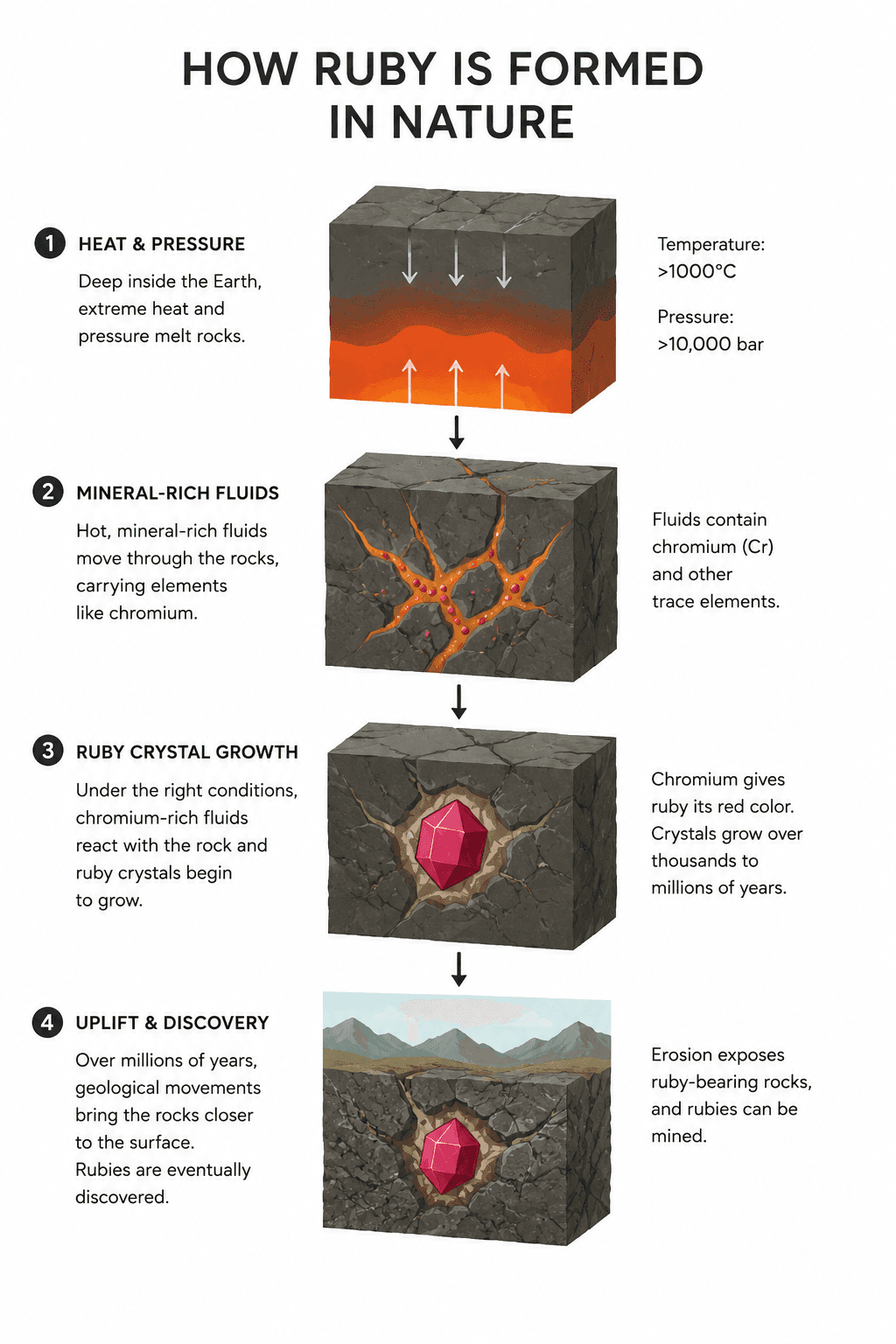
Natural rubies are the result of rare, ancient geological events. They formed millions of years ago deep within the Earth's crust, frequently inside metamorphic rocks like marble or basalt.
This happened where tectonic plates collided under immense heat and extreme pressure.
Because nature lacks a sterile environment, these stones captured tiny fragments of surrounding minerals as they crystallized. Gemologists view these internal characteristics as unique birthmarks that tell the story of the Earth's violent history.
Natural rubies are the result of rare, ancient geological events. They formed millions of years ago deep within the Earth’s crust, frequently inside metamorphic rocks like marble or basalt.
This happened where tectonic plates collided under immense heat and extreme pressure.
Because nature lacks a sterile environment, these stones captured tiny fragments of surrounding minerals as they crystallized. Gemologists view these internal characteristics as unique birthmarks that tell the story of the Earth’s violent history.

Lab-Grown Rubies: Mastered Scientific Precision
Flame Fusion (The Verneuil Method): Invented by Auguste Verneuil in 1902, this approach liquefies a fine powder mixture of aluminum oxide and chromium using an intense oxyhydrogen flame exceeding 2,000°C. The molten droplets fall onto a rotating pedestal, cooling rapidly into a teardrop-shaped crystal called a boule. This efficient process can produce a large crystal in a matter of hours.
Flux Growth: This intricate method mixes mineral nutrients with a specialized liquid solvent called a flux inside a crucible. The mixture is heated to high temperatures and then cooled at an incredibly slow rate over several months. Crystals grow gradually around a tiny ruby seed plate. This mimics the slow pace of natural formation and yields a remarkably convincing stone.
Telling Them Apart: Visual Indicators and Inclusions
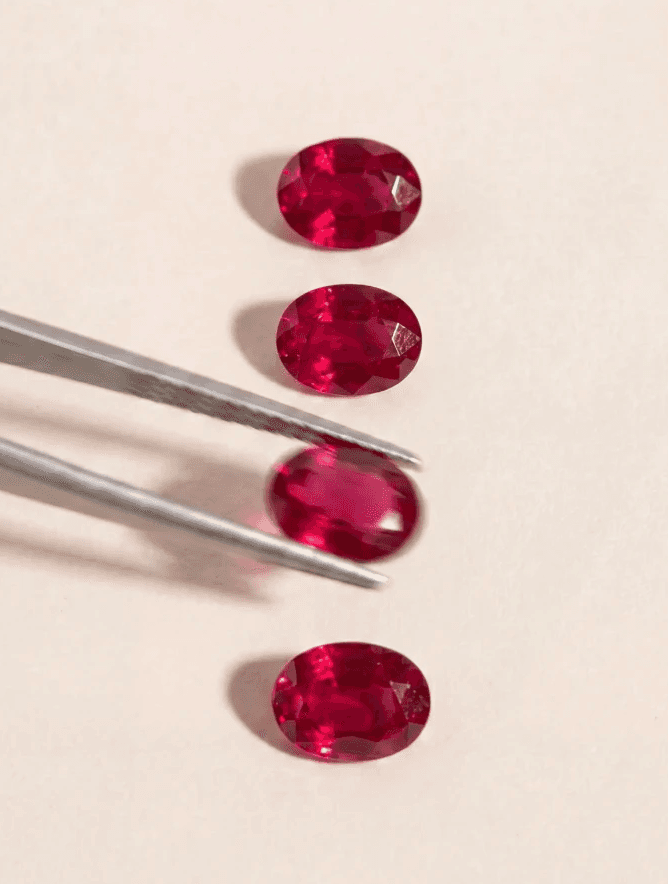
The untrained eye cannot see the difference between a natural ruby and a high-quality lab gem. Professional gemologists look deep inside the stone using specialized microscopes to find the telltale signs of origin. Clarity and Fingerprints Natural rubies are rarely flawless. They typically feature inclusions known as "silk," which are tiny, intersecting needles of the mineral rutile. This silk diffuses light beautifully, softening the color distribution. You may also observe jagged liquid fractures resembling fingerprints. Lab-grown alternatives show patterns tied to their specific manufacturing environment. Flame-fusion gems display curved growth lines or microscopic, spherical gas bubbles. Flux-grown options frequently contain tiny metallic platelets or lingering traces of the flux solution. Color Consistency Natural rubies often showcase color zoning, displaying bands of lighter and darker red caused by fluctuating chemical levels during growth. Lab-grown options maintain uniform color saturation throughout the gemstone, resulting in an exceptionally vivid look.
Telling Them Apart: Visual Indicators and Inclusions
The untrained eye cannot see the difference between a natural ruby and a high-quality lab gem. Professional gemologists look deep inside the stone using specialized microscopes to find the telltale signs of origin. Clarity and Fingerprints Natural rubies are rarely flawless. They typically feature inclusions known as "silk," which are tiny, intersecting needles of the mineral rutile. This silk diffuses light beautifully, softening the color distribution. You may also observe jagged liquid fractures resembling fingerprints. Lab-grown alternatives show patterns tied to their specific manufacturing environment. Flame-fusion gems display curved growth lines or microscopic, spherical gas bubbles. Flux-grown options frequently contain tiny metallic platelets or lingering traces of the flux solution. Color Consistency Natural rubies often showcase color zoning, displaying bands of lighter and darker red caused by fluctuating chemical levels during growth. Lab-grown options maintain uniform color saturation throughout the gemstone, resulting in an exceptionally vivid look.
Side-by-Side Comparison: Value, Impact, and Practicality
Side-by-Side Comparison: Value, Impact, and Practicality
Choosing the ideal gemstone depends on prioritizing what matters most to you, whether that means rarity, budget constraints, or environmental sustainability.
Market Dynamics and Cost
Natural rubies are exceptionally rare, especially in weights exceeding 1.0 carat. A high-quality mined ruby can cost anywhere from $1,000 to over $15,000 per carat, with premium "pigeon's blood" specimens commanding incredible auction records.
Lab-grown alternatives offer magnificent beauty at a more predictable investment level, typically ranging from $100 to $1,000 per carat. This affordability lets buyers focus their budget on elaborate custom settings or larger focal stones.
Sustainability and Ethical Frameworks
Mined rubies require significant earth removal, which carries an environmental footprint. While modern ethical mining initiatives support local communities, verifying chain-of-custody documentation remains essential.
Lab creation eliminates mining disruption and offers a highly transparent supply chain. The environmental footprint of a lab ruby centers primarily on the energy demands of operating high-temperature furnaces.
Investment Longevity
Mined rubies function like fine art. Their scarcity drives value appreciation over time, making them solid generational investments. Lab-grown choices do not hold reselling power similarly because production capabilities will continue to grow alongside advancing technology. They are bought for their immediate beauty and wearability rather than financial speculation.
Choosing the ideal gemstone depends on prioritizing what matters most to you, whether that means rarity, budget constraints, or environmental sustainability.
Market Dynamics and Cost
Natural rubies are exceptionally rare, especially in weights exceeding 1.0 carat. A high-quality mined ruby can cost anywhere from $1,000 to over $15,000 per carat, with premium “pigeon’s blood” specimens commanding incredible auction records.
Lab-grown alternatives offer magnificent beauty at a more predictable investment level, typically ranging from $100 to $1,000 per carat. This affordability lets buyers focus their budget on elaborate custom settings or larger focal stones.
Sustainability and Ethical Frameworks
Mined rubies require significant earth removal, which carries an environmental footprint. While modern ethical mining initiatives support local communities, verifying chain-of-custody documentation remains essential.
Lab creation eliminates mining disruption and offers a highly transparent supply chain. The environmental footprint of a lab ruby centers primarily on the energy demands of operating high-temperature furnaces.
Investment Longevity
Mined rubies function like fine art. Their scarcity drives value appreciation over time, making them solid generational investments. Lab-grown choices do not hold reselling power similarly because production capabilities will continue to grow alongside advancing technology. They are bought for their immediate beauty and wearability rather than financial speculation.
The Verdict: Which Ruby is Right For You?
Every path leads to a breathtaking piece of jewelry. Your final decision rests on which narrative speaks directly to you. A natural ruby is the ideal fit if: You cherish historical allure, ultimate scarcity, and organic imperfections. You are shopping for an investment-grade piece that holds or increases its financial value. You find joy in owning a rare fragment of planetary history. A lab-grown ruby is the perfect choice if: You want a vibrant crimson gem with maximum clarity and color impact. You want to maximize your budget for a larger focal gemstone or an intricate setting. You prefer a transparent source that sidesteps traditional mining operations. Regardless of your choice, ensure your final selection includes documentation from a trusted gemological authority. This provides complete confidence in the authenticity and origin of your stunning ruby jewelry.
The Verdict: Which Ruby is Right For You?
Every path leads to a breathtaking piece of jewelry. Your final decision rests on which narrative speaks directly to you. A natural ruby is the ideal fit if: You cherish historical allure, ultimate scarcity, and organic imperfections. You are shopping for an investment-grade piece that holds or increases its financial value. You find joy in owning a rare fragment of planetary history. A lab-grown ruby is the perfect choice if: You want a vibrant crimson gem with maximum clarity and color impact. You want to maximize your budget for a larger focal gemstone or an intricate setting. You prefer a transparent source that sidesteps traditional mining operations. Regardless of your choice, ensure your final selection includes documentation from a trusted gemological authority. This provides complete confidence in the authenticity and origin of your stunning ruby jewelry.
Contact us to buy Lab-Created Rubies, wholesale, retail or direct.