What AIGS and Gemmology Schools See When They Grade a Stone and Why It Matters to you

Vinamra Gupta
Author
AIGS, the Asian Institute of Gemological Sciences, is one of Asia's oldest gemological institutes, based right here in Bangkok. The JK Diamond Institute trains the next generation of diamond graders and traders. Both of these institutes visited the Lab Grown Dreams office - find out why.

[Journal]
Something happened at our office recently that I am still a little proud of. The Asian Institute of Gemological Sciences, AIGS, one of the most respected gem labs and schools in Asia, came to Lab Grown Dreams at the Jewelry Trade Center. Not for a sales meeting. They came to source lab grown gemstones, and we donated three lab grown specimens to them for study and reference.
A few days before that, students and educators from the JK Diamond Institute visited our office to learn about lab grown material directly from us. I wrote about both visits when they happened, the AIGS visit to source lab grown gems and why gemological schools come to Lab Grown Dreams, and you can read the full stories there.
Think about what that means for a second. The institutions that train the people who grade stones, and the labs that the trade itself trusts, came to a workshop on Silom Road to look at lab grown material. Sitting across the table from graders and educators, watching them work through our stones, reminded me how little the public actually knows about what happens when a stone gets graded.
So let me open that door. This is what professionals actually look at when they grade a stone, why it took them hours when it takes a mall salesperson thirty seconds, and why all of it matters when you are the one paying.
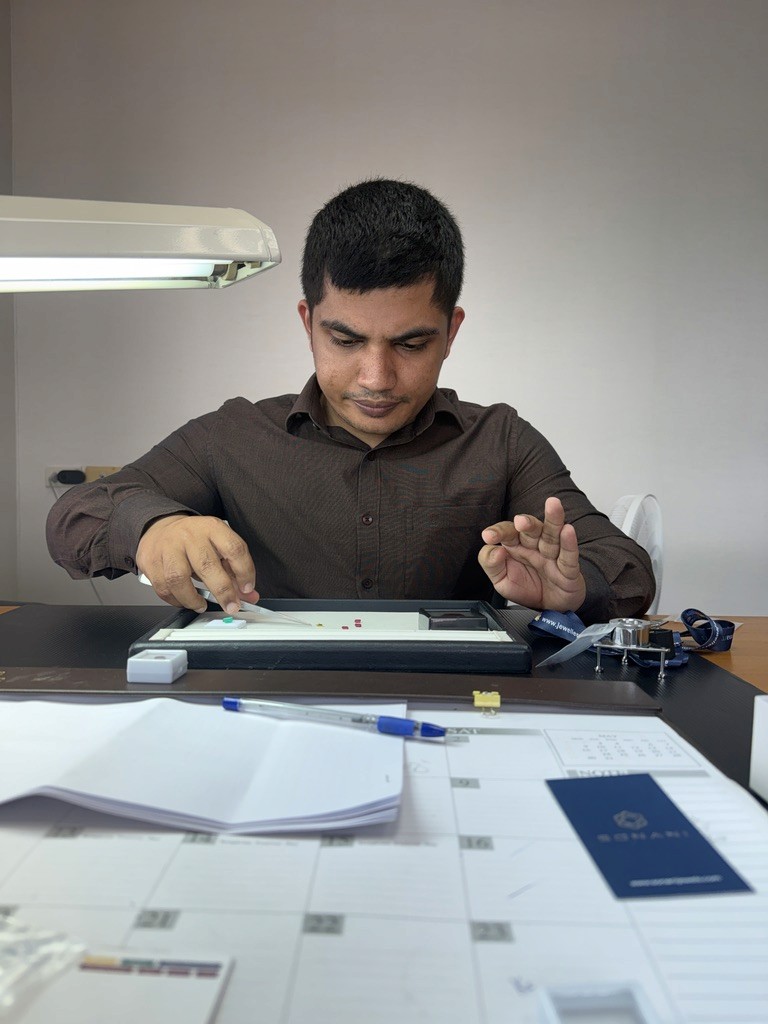
Professor Akiff Faleel from AIGS checking Rubies at Lab Grown Dreams office.
Who AIGS and JK Diamond Institute Are, For Those Outside the Trade
If you are inside the Bangkok gem trade, these names need no introduction. If you are not, here is the short version.
AIGS, the Asian Institute of Gemological Sciences, is one of Asia’s oldest gemological institutes, based right here in Bangkok. They run a respected laboratory and school, and their reports and training carry serious weight across the colored stone and diamond world. When AIGS wants reference material for lab grown gemstones, they go looking for the best examples they can find. This past July, that search brought them to us, and three of our lab grown specimens are now with AIGS.
The JK Diamond Institute trains the next generation of diamond graders and traders. Their students came to our office to see lab grown diamonds and gemstones up close, ask questions, and understand how this material is grown, cut, and certified. Schools do not bring students to businesses they do not trust.
I am not telling you this to show off. Fine, maybe a little. But mostly I am telling you because in a trade full of claims, the strongest credential is not what a seller says about themselves. It is who shows up at their door. And in our case, the graders themselves showed up.
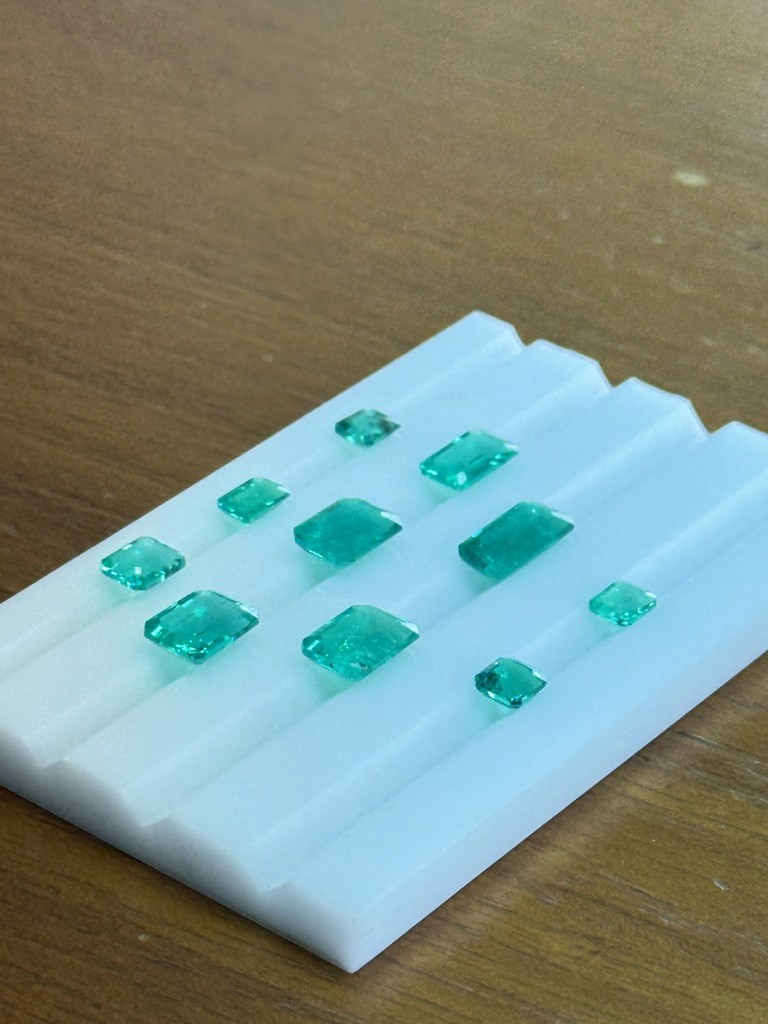
A selection of Hydrothermal Emeralds at Lab Grown Dreams office.
What a Grader Actually Sees
When you hand a professional grader a stone, they are not admiring it. They are interrogating it. Here is roughly what happens, whether the stone is mined or grown.
Identity comes first. Before anything else, the grader confirms what the material actually is. Diamond, sapphire, spinel, simulant. Refractive index, specific gravity, spectroscopy. This is the step that catches every fake, and it is the reason I keep telling people that certification matters more than any promise a seller makes.
Origin comes second. For diamonds, this is where the lab determines mined versus lab grown, and for lab grown, whether it is CVD or HPHT. Growth patterns, fluorescence behavior, trace element signatures. Here is the detail most people miss: it takes advanced laboratory equipment to make this call, because to every standard instrument, and to your eye, the material is simply diamond. When people ask me if lab grown diamonds are real, this is my answer. The world’s best laboratories need specialized machines to tell them apart from mined stones. That is how real they are.
Then the 4Cs. Color graded against master sets under controlled lighting. Clarity mapped inclusion by inclusion under magnification, and every inclusion plotted on the report diagram. Cut measured for proportions, symmetry, and polish. Carat weight to the thousandth. This is slow, careful, boring work, and it is exactly the work that protects you.
Everything gets documented. The result is the report, with a number you can type into the IGI, GIA, or AIGS website and verify from your own phone. That number is the whole game. Our Education Center goes deeper into how to read these reports if you want to study before you buy.
Why the Institutes Are Studying Lab Grown Material Now
Here is the part that connects the visits to your next purchase.
Grading laboratories and schools exist to keep the trade honest, and to do that they have to stay ahead of the material entering the market. Lab grown diamonds and colored stones are no longer a curiosity. They are a major and growing share of what crosses grading desks every day. The institutes know this, which is why AIGS is building reference collections of lab grown material and why JK Diamond Institute is putting real stones in front of students.
The specimens we donated to AIGS will help train the eyes and calibrate the instruments that keep this market trustworthy. That matters to me personally. I have said before that I would rather lead this change in Bangkok than resist it, and there is no better way to lead than to put your own stones on the grading bench of the most demanding audience in Asia and say, here, study these.
For you as a buyer, the takeaway is simple. The institutions at the top of this trade are treating lab grown as a permanent, serious category. The debate is over in the rooms where it counts. What is left is the noise from retailers protecting old margins.

Students from JK Diamond and Jewelry Institute analyzing Lab Diamonds and other Lab Created Gems at Lab Grown Dreams Office.
What This Means When You Buy From Us
Everything the graders check is everything we check first, because our stones have to survive their scrutiny. In practice, buying from Lab Grown Dreams works like this.
Every diamond we sell carries an IGI or GIA report, and I encourage you to verify the number online before any money changes hands. Our CVD diamonds are certified stones with certificates you can check from anywhere in the world, and our CVD price list for Bangkok shows what those certified stones cost when you buy at factory price from the source, with no middleman between the grading lab and your hand.
Our lab grown colored stones, the emeralds, rubies, and sapphires, are cut in-house from material good enough that AIGS wanted examples of it for their own collection. I honestly cannot think of a better quality endorsement in this city.
And when we turn those stones into finished pieces, the same standard follows the stone into the setting. You can order custom jewelry starting with nothing but an idea, and the certificate travels with the finished piece.
The Question to Ask Any Seller in Bangkok
After reading this, you are armed with the only question that separates real dealers from everyone else in this city.
“Can I verify the certificate online right now?”
A real dealer says yes and helps you do it on the spot. Anyone who hesitates, changes the subject, or tells you their own guarantee is just as good has answered a different question, the one about whether you should be buying from them at all.
I built this business so that the answer at our counter is always yes, immediately, on your phone, before you commit a single baht. The graders trust the process. The institutes teach the process. You should demand the process.
Come see it for yourself at the Jewelry Trade Center, 919 Silom Road, or start the conversation on WhatsApp. Bring your hardest questions. After hosting AIGS and JK Diamond Institute, I promise yours will feel easy.
Frequently Asked Questions
Did AIGS visit Lab Grown Dreams? Yes. The Asian Institute of Gemological Sciences visited Lab Grown Dreams at the Jewelry Trade Center in Bangkok to source lab grown gemstones, and Lab Grown Dreams donated three lab grown specimens to AIGS for study and reference.
What is the JK Diamond Institute connection to Lab Grown Dreams? Students and educators from the JK Diamond Institute visited the Lab Grown Dreams office in Bangkok to learn about lab grown diamonds and gemstones directly from the company, examining material up close as part of their gemological education.
What do gemological labs check when grading a diamond? Labs first confirm the material’s identity, then determine its origin as mined or lab grown, then grade the 4Cs: color, clarity, cut, and carat weight, under controlled conditions. The results are documented in a report with a unique number that can be verified on the laboratory’s website.
Can laboratories tell lab grown diamonds from mined diamonds? Yes, but only with advanced laboratory equipment that reads growth patterns and trace signatures. Standard diamond testers and the human eye cannot tell them apart, because lab grown diamonds are chemically and physically identical to mined diamonds.
Which diamond certifications can be verified online? IGI, GIA, and AIGS reports can all be verified on each laboratory’s official website using the report number. Verifying the certificate before paying is the single most important step when buying any diamond or gemstone in Bangkok.
Where can I buy AIGS-recognized quality lab grown gemstones in Bangkok? At Lab Grown Dreams in the Jewelry Trade Center on Silom Road, the same source AIGS visited to obtain lab grown gemstone specimens for its reference collection. All stones are sold at factory price with independent certification.