What to Bring to Your First Bespoke Jewelry Consultation in Bangkok

Vinamra Gupta
Author
[Journal]
You have booked the appointment. Somewhere between the excitement and the slight nervousness, a practical question shows up: what am I actually supposed to bring to this?
I have sat across the design table from thousands of people at this point, and I can tell you the difference between a good first consultation and a great one is almost never the budget. It is the preparation. The clients who walk in with a few simple things in hand leave that same meeting with a design brief we can actually build, sometimes a finished concept, instead of a vague conversation we have to repeat next week.
So here is the honest, insider list. Bring these, and your first bespoke jewelry consultation stops being a chat and starts being the moment your piece begins.
The Short Version, On One Card
If you read nothing else, screenshot this.
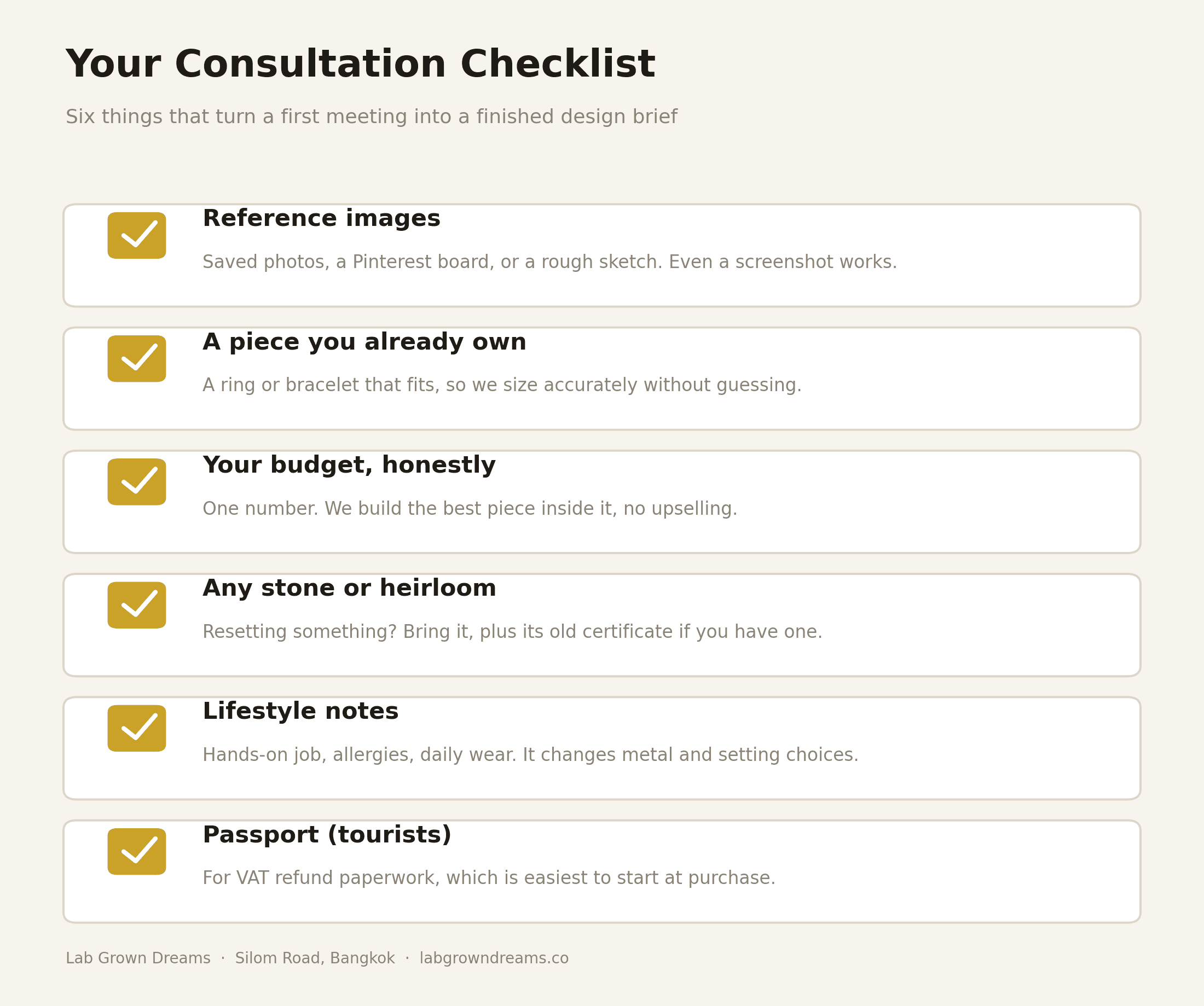
Now let me explain why each one matters more than you would think, and share a few things that even seasoned buyers forget.
1. Inspiration, in Any Form You Have It
You do not need to arrive knowing exactly what you want. You need to arrive with enough for us to read your taste. A saved folder on your phone, a Pinterest board, screenshots, a photo of something you spotted on someone’s hand, or a scribble on the back of a receipt. All of it is useful. Contradictory images are useful too, because the disagreements between them tell a designer as much as the agreements.
A quiet tip most people miss: bring one or two images of designs you actively dislike. Knowing what to steer away from sharpens a commission faster than a hundred things you sort of like. I wrote about how this translation from picture to piece really works in what happens when you bring us a Pinterest board, and it starts with exactly this raw material.
2. A Piece That Already Fits
This is the single most overlooked item, and it solves the trickiest part of any ring commission: size.
Bring a ring the wearer already wears comfortably on the correct finger. From that one object we can size a new piece precisely, no guesswork, no awkward “I think she’s about a medium.” If the piece is a surprise and you cannot borrow a ring, do not panic, and do not measure their finger while they sleep, which never works as well as the internet claims.
Instead, try this at home first:
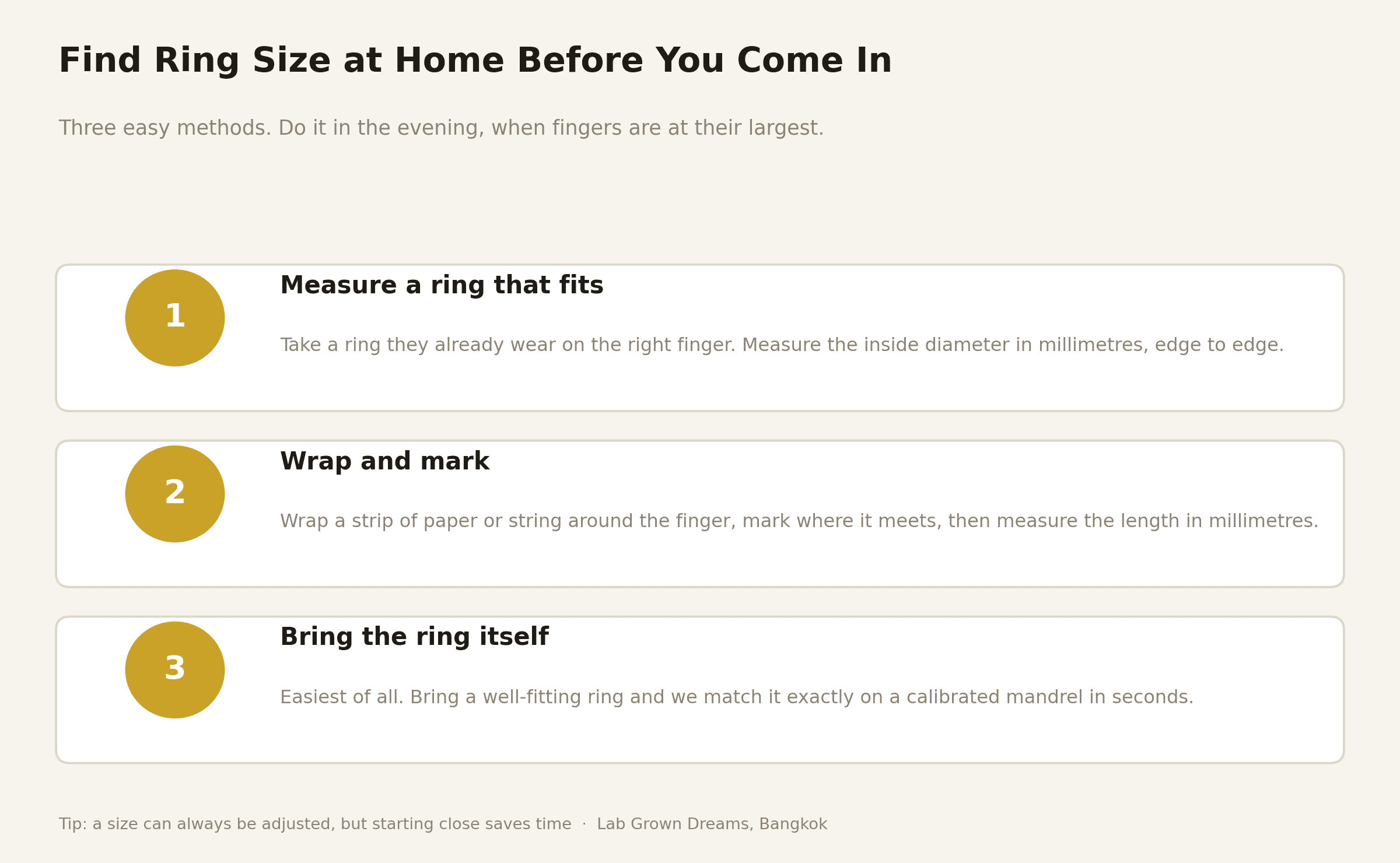
Do it in the evening, because fingers swell slightly through the day and you want the larger, truer size. Get close at home, and we fine-tune on a calibrated mandrel when you come in. A made to order ring can always be adjusted, but starting near the mark saves everyone time.
3. Your Real Budget, Said Out Loud
I know talking money feels uncomfortable, so let me make it easy. Your budget is not something a good designer negotiates against. It is the frame we design inside. Tell me one honest number and my entire job becomes maximising the stone and the craftsmanship within it.
It also helps to understand where that number tends to go, so the split does not surprise you:
In most pieces the center stone commands the largest share, which is precisely why the choice of a lab created stone changes everything. Because lab created diamonds and colored stones cost a fraction of mined equivalents, that dominant slice of your budget suddenly stretches into a bigger, cleaner, or finer stone than you thought possible, without touching the quality of the metal or the making. If you want to calibrate expectations before the meeting, our published price list shows real numbers.
4. The Stone or Heirloom You Want to Reimagine
Some of the most meaningful commissions I have worked on started with an old piece. A grandmother’s ring that never gets worn. Inherited stones sitting in a drawer. A first engagement ring being reimagined for an anniversary.
If that is your story, bring the piece. Bring any certificate or documentation that came with it too, even if it is decades old, because it helps us understand the stones before we touch them. We can often rescue and reset original stones into something worn daily, or pair them with new lab created stones to build the scale you want affordably. Nothing is promised until we have examined it, but the possibilities usually surprise people.
5. Notes About the Life the Piece Will Live
Here is where experience separates a piece that gets worn from a piece that lives in a box. A design has to fit a life, not just a finger.
Tell us the practical things. Does the wearer work with their hands, type all day, wear gloves, play an instrument? Any metal sensitivities or skin reactions to certain alloys? Is this an everyday piece or a special-occasion one? A high, sharp setting that photographs beautifully can be the wrong answer for a nurse or a potter, and a good designer would rather know that on day one.
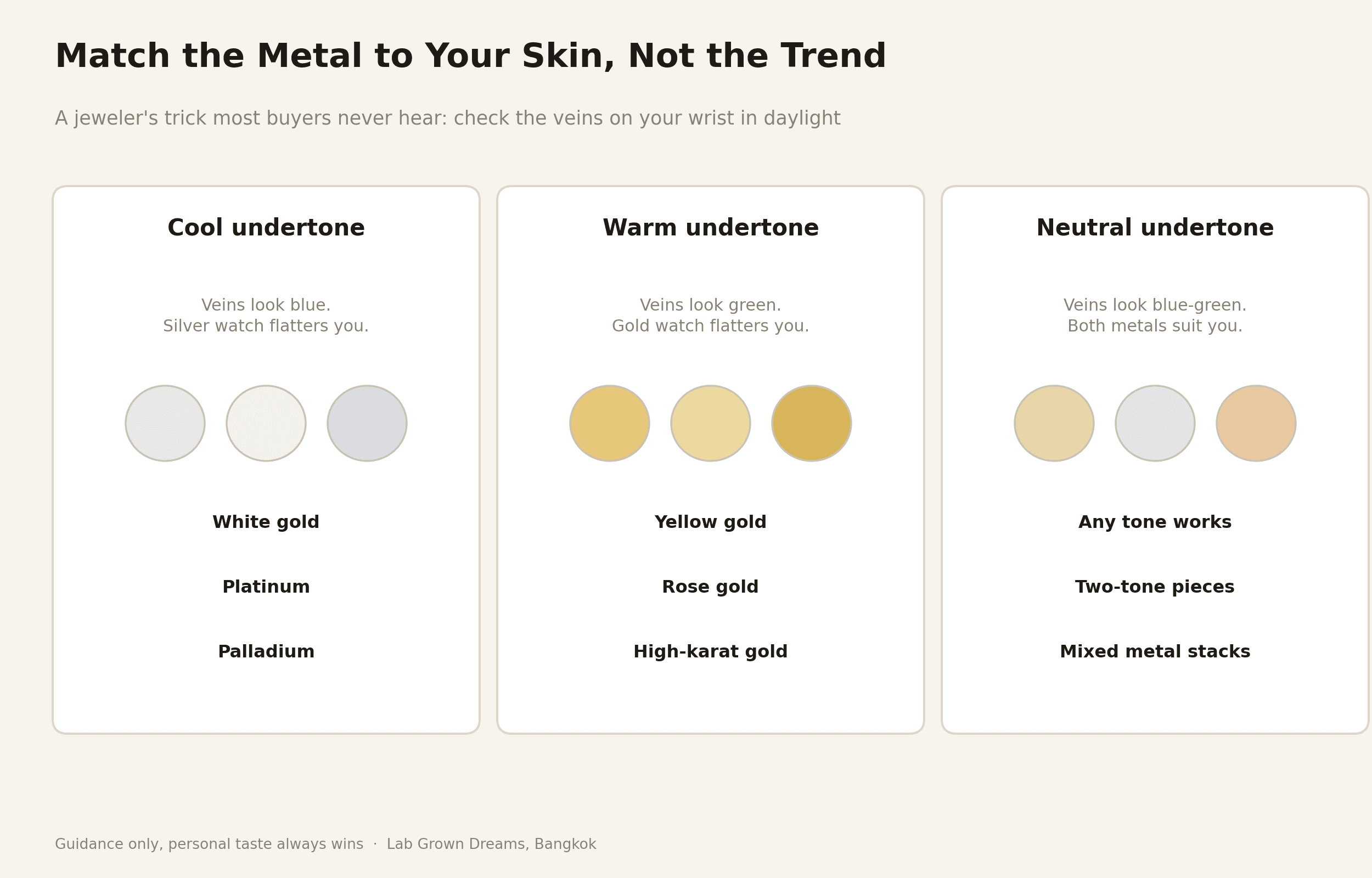
And a genuinely useful one that almost nobody thinks to consider before choosing metal:

Glance at the veins on the inside of your wrist in natural daylight. Bluish tends to sit in the cool family, where white metals sing. Greenish leans warm, where yellow and rose golds glow. Blue-green is neutral, lucky you, everything works. It is guidance, not law, and personal taste always wins, but it is the kind of thing a thoughtful jeweller raises and most sellers never mention.
6. Your Passport, If You Are Visiting
A small, practical one for travelers. If you are visiting Thailand, bring your passport to the consultation. It makes starting the VAT refund paperwork straightforward, and eligible purchases can reclaim tax on departure with the correct forms. It is far easier to set up at the start than to chase afterward.
[STOCK IMAGE PLACEHOLDER 2: A finished bespoke ring in a hand by a window, natural light. Replace with your own finished-piece photo. Alt text: “Finished made to order ring with a lab created center stone crafted in Bangkok”]
One Thing You Do Not Need to Bring: Deep Gem Knowledge
You do not need to arrive fluent in the 4Cs. That is my job, and I enjoy it. But if you like walking in informed, the best places to read first are the laboratories themselves rather than any jeweller’s blog, mine included. The GIA guide to the 4Cs, the IGI education resources, and Bangkok’s own AIGS all explain grading without a sales agenda.
I mention them for a reason beyond good manners. Every stone we set comes with an independent certified report you can verify on these laboratories’ own websites, and these are institutions we know from both sides of the counter. AIGS has come to our office to source lab created gemstones for their own reference collection, a story I told in what the grading institutes look for. Walking in already trusting the paperwork makes the whole consultation lighter.
What Happens After You Walk In Prepared
When you arrive with these things, the meeting flows. We read your inspiration, size from your reference piece, choose stones live against your budget, talk through the life the piece will live, and often sketch or start a CAD direction before you leave. From there, a made to order piece typically takes one to two weeks, and we can move faster for travelers on a deadline, something we have done down to a single airport layover.
You do not have to be a jewelry expert to get an expert result. You just have to arrive ready, and let 35 years of family craft do the rest.
Book your consultation on WhatsApp or start your commission online, and bring the list. Lab Grown Dreams, 919 Silom Road, Bangkok.
Frequently Asked Questions
What should I bring to a bespoke jewelry consultation? Bring inspiration images, a ring that already fits the correct finger for sizing, your honest budget, any heirloom or stone you want reset along with its documentation, notes on the wearer’s lifestyle and any metal sensitivities, and your passport if you are a visitor to Thailand for VAT purposes.
How do I find ring size before a jewelry appointment? Measure the inside diameter of a ring the person already wears, or wrap a strip of paper around the finger and measure its length, ideally in the evening when fingers are largest. Bringing a well-fitting ring to the appointment is the most accurate option, as it can be matched exactly on a mandrel.
Do I need to know about diamonds before a design consultation? No. A good designer guides you through stone selection. If you prefer to read first, the GIA, IGI, and AIGS websites explain diamond grading impartially. Every stone from a reputable jeweller should come with an independent certificate you can verify online.
What is a lab created diamond? A lab created diamond is a real diamond grown in a controlled setting rather than mined, identical in chemistry, physics, and appearance to a mined diamond, and graded by the same laboratories. It typically costs a fraction of a mined stone, which lets a bespoke budget go toward a larger or finer center stone.
How long does a made to order piece take in Bangkok? Most made to order and bespoke pieces take one to two weeks from design approval to completion. Faster turnarounds are possible for travelers with limited time when all production is handled in-house.
Can I have a consultation if I am only visiting Bangkok briefly? Yes. Consultations can begin remotely over WhatsApp before you arrive, with stone viewing on video and design sketches shared in advance, so an in-person visit becomes a quick confirmation rather than a starting point. This suits tourists and travelers with tight schedules.
Keep reading: What Happens When You Walk In With a Pinterest Board The Complete Insider Guide to Buying Custom Jewelry in Bangkok Six Days, One Layover: A Custom Ring Delivered at the Airport Start Your Commission