The US and Thailand Are Reshaping Gemstone Trade: What It Actually Means for Buyers

Vinamra Gupta
Author

[Journal]
The US and Thailand Are Reshaping Gemstone Trade: What It Actually Means for Buyers
There is a quiet but genuinely important story unfolding in my industry right now, and most buyers have no idea it affects them. The United States and Thailand are moving toward restoring duty-free trade for coloured gemstones, a shift that could change prices, supply, and sourcing decisions for anyone who buys stones from Thailand, which is to say a huge portion of the jewellery world.
The trade body leading this effort, the American Gem Trade Association, recently met with senior members of the Royal Thai Government to push it forward, and I will point you to their reporting on it below. But here is the thing: AGTA's announcement is written for the trade, in the language of policy. I sit in the middle of this industry, at the Jewelry Trade Center on Silom Road in Bangkok, where my family has worked for over 35 years. So let me do something more useful than repeat a press release. Let me tell you what this actually means for you as a buyer or a brand, and where a part of this market that nobody in the tariff conversation is talking about, lab-grown, quietly fits in.
First, What Happened
Let me set out the facts, and I want to be clear about the source, because this is AGTA's reporting and they deserve the credit for the work.
AGTA Meets With Royal Thai Government', agta.org" and a link to the article. Choose the passage about the meeting with the Deputy Trade Minister and the push for the US–Thailand Agreement on Reciprocal Trade.
Read the full article here
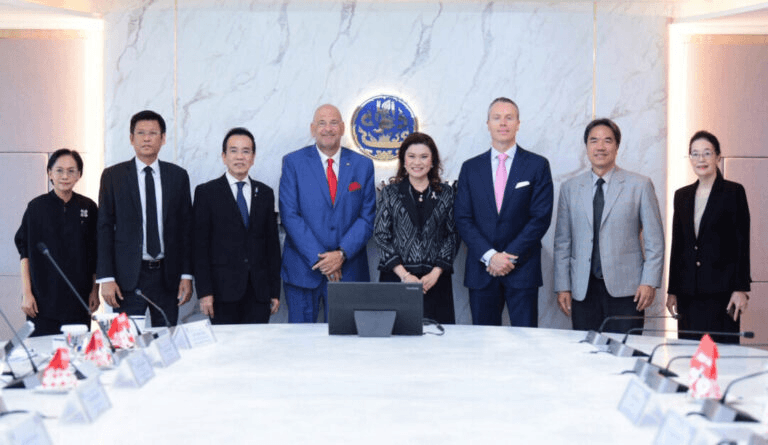
In plain terms, according to AGTA, its leadership travelled to Bangkok for a private meeting with senior Royal Thai Government officials to press for a swift conclusion to a US–Thailand reciprocal trade agreement, one that would help restore favourable tariff treatment for Thai coloured gemstones entering the United States. It is a significant piece of trade diplomacy, and it matters because the US is the single largest market for coloured stones in the world.
What's Actually Happening at the Border
The mechanics can sound intimidating, so here is the simple version of how a change like this actually moves.

A framework for a reciprocal trade agreement gets agreed between the two countries. The industry then petitions for loose gemstones to be included under the tariff arrangements for aligned trading partners. If that is approved, qualifying Thai gemstones would enter the US at a zero-percent reciprocal tariff, and it becomes official through a formal government notice, following the pattern of similar recent agreements. Each of these steps is reported in detail by the trade bodies, and I would point you to AGTA and the trade press for the authoritative blow-by-blow.
What It Means for You as a Buyer or a Brand
Here is where I can add something the policy announcement does not. What does this actually mean if you buy stones, or build a jewellery business?
If you are a US-based buyer or brand sourcing natural coloured gemstones from Thailand, a return to duty-free treatment is straightforwardly good news. It would ease cost pressure on stones entering the US and make Thai-sourced colour more competitive again. If you have felt the squeeze of tariff uncertainty over the past couple of years, this is the industry working, hard, to relieve it.
But there is a subtler point, and it is the one I most want you to take away. Trade policy is, by its nature, uncertain and slow. It moves with governments, negotiations, and formal notices, and it can shift again with the next administration or the next dispute. Building a business entirely on stones whose price and availability swing with cross-border politics means accepting that volatility as a permanent feature. And that is exactly where a part of this market that the tariff conversation ignores becomes very interesting.
The Dimension Nobody in This Conversation Is Talking About
Every article about this trade story, AGTA's included, is about natural coloured gemstones, mined abroad and moving across borders. That is AGTA's world, and they are the authority in it. But it is not the whole of colour anymore.
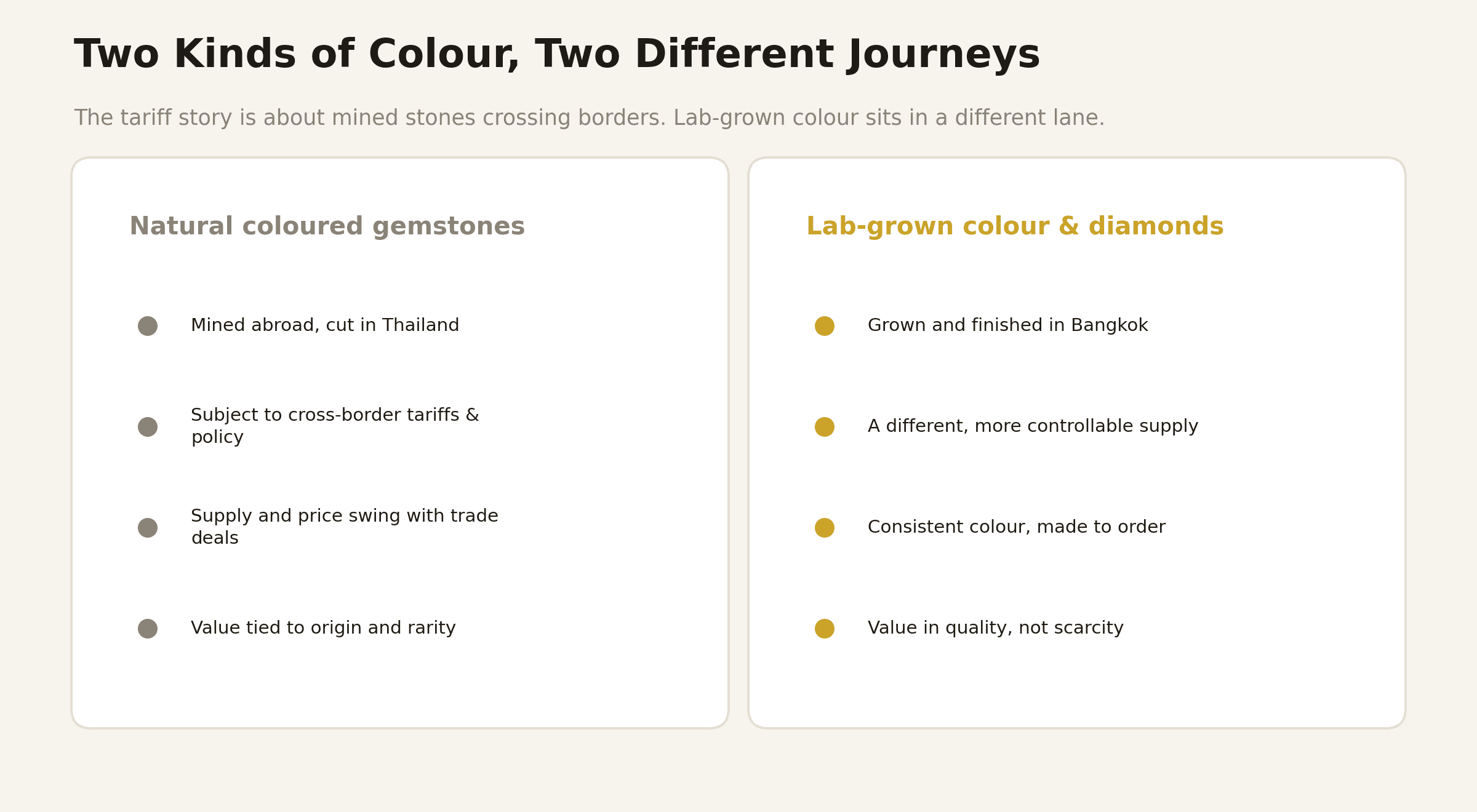
Lab-grown colour and lab-grown diamonds sit in a fundamentally different lane. We grow and finish our lab-grown corundum, our lab-grown emeralds, rubies, and sapphires, and our certified lab-grown diamonds right here in Bangkok. That means a more controllable supply, consistent colour made to order rather than found by chance, and value that rests on quality and craftsmanship rather than on scarcity and the shifting winds of trade policy.
I am not saying this to diminish natural stones. A fine natural gem carries a romance and rarity that is real, and the work AGTA is doing to protect that trade is genuinely important for the whole industry. What I am saying is that a smart buyer or brand in 2026 should understand both lanes. Natural colour, with its rarity and its trade-policy exposure. And lab-grown colour, with its consistency, its honest pricing, and its insulation from the tariff drama. The most resilient jewellery businesses I see are the ones that understand where each fits.
Why This Is All Happening in Bangkok
One last point worth making, because it is the thread that ties this together. All of this, the AGTA meeting, the trade negotiations, the cutting, the growing, is happening in and around Bangkok because Thailand is one of the true centres of the global gem and jewellery world. The expertise here, in cutting, treatment, and craftsmanship, is why the US trade body flew to this city to meet this government, and it is the same expertise we put to work on every piece we make.
That is the quiet advantage of working with a house that is physically here, in the trade, rather than a step removed from it. We feel these shifts first, we understand them from the inside, and we help our clients navigate them, whether they want the finest natural colour or the consistency and value of lab-grown.
Where We Fit
If any of this affects your buying, or you simply want to understand your options across both natural and lab-grown colour, that conversation is exactly what we are here for. We supply certified lab-grown diamonds and coloured stones, and finished custom jewellery, directly from Bangkok to buyers and brands in the US, UK, EU, and the Middle East, and we are happy to talk through the trade landscape as part of it. For trade buyers specifically, our B2B sourcing guide covers how working with us at the source actually works.
Message me on WhatsApp or browse the corundum colour catalogue. Lab Grown Dreams, at the Jewelry Trade Center, Silom Road, Bangkok.
The trade-policy developments described here are reported by the American Gem Trade Association and the trade press; see the cited sources for the authoritative detail. This article is our own commentary on what those developments mean for buyers.
Frequently Asked Questions
What is happening with US-Thailand gemstone trade? According to the American Gem Trade Association, the US and Thailand are working toward a reciprocal trade agreement that would help restore duty-free treatment for Thai coloured gemstones entering the United States. AGTA leadership met with senior Royal Thai Government officials to advance this, and the process involves petitioning for loose gemstones to qualify for a zero-percent reciprocal tariff.
Will gemstones from Thailand become cheaper in the US? If the reciprocal tariff treatment is approved, qualifying Thai coloured gemstones would enter the US duty-free, which would ease cost pressure for US buyers and brands sourcing from Thailand. The exact timing depends on the formal trade process, so buyers should follow the trade bodies for confirmation.
Does this tariff change affect lab-grown gemstones and diamonds? The trade-policy discussion centres on natural coloured gemstones crossing borders. Lab-grown colour and diamonds sit in a different, more controllable supply lane, grown and finished to order, with value based on quality rather than scarcity, which insulates them from much of the tariff volatility affecting mined stones.
Why is Thailand so central to the gemstone trade? Thailand, and Bangkok in particular, is one of the world's leading centres for gemstone cutting, treatment, craftsmanship, and trade. This depth of expertise is why international trade bodies engage directly with the Thai government and industry, and why so much of the world's colour passes through the country.
Should I buy natural or lab-grown coloured stones? Both have a place. Natural stones offer rarity and origin romance but carry trade-policy and supply exposure. Lab-grown offers consistent, made-to-order colour, honest pricing, and insulation from tariff volatility. The right choice depends on your goals, and a knowledgeable supplier can help you weigh both.
Where can I source gemstones directly from Bangkok? Lab Grown Dreams supplies certified lab-grown diamonds and coloured stones and finished custom jewellery directly from the Jewelry Trade Center in Bangkok to buyers and brands worldwide, with certification, video viewing, and insured shipping.
Keep reading: Lab-Grown Diamond Wholesale in Bangkok: A B2B Sourcing Guide The Full Corundum Colour Catalogue Bangkok Gem Fair 2026: An Insider's Guide for Smart Buyers Fancy Coloured Lab-Grown Diamonds: Pink, Blue, Yellow and Beyond