Why Rappers Are Quietly Switching to Lab-Grown Iced Out Pieces

Vinamra Gupta
Author
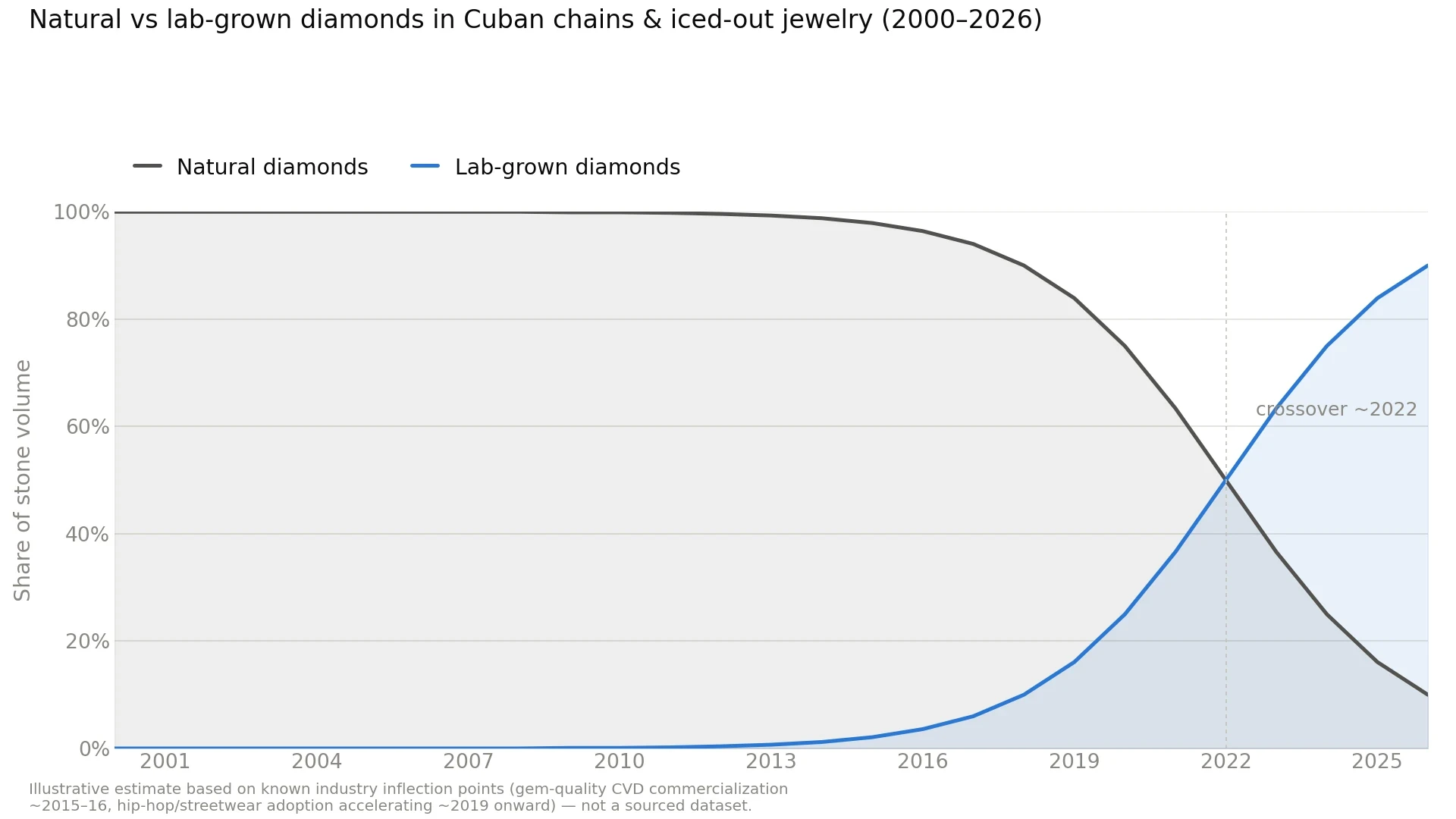
The shift is happening quietly, but it's happening fast. From chain links to tennis bracelets, lab-grown diamonds are becoming the default for hip-hop's biggest flexes — and the reasons go deeper than the price tag.

[Journal]
Why the Smartest Guys in Hip-Hop Are Going Lab-Grown
Lab-grown diamonds are quietly rewriting the rules of iced-out jewelry — bigger carats, lower cost, conflict-free sourcing. Here's why the flex is changing.
The culture of flexing has always been about showing what you can get. And right now, what the smartest guys in the room are getting is lab-grown.
For decades, the iced-out flex ran on one currency: scarcity. A bigger chain meant more mined diamonds pulled out of the ground, and more mined diamonds meant more money spent chasing a finite supply. That math hasn't changed for mined stones. What's changed is that there's now a second currency in the game — one that doesn't play by the old rules of scarcity at all.
Lab-grown diamonds have moved from "budget alternative" to serious flex material, and the shift is happening fastest at the top of the market, not the bottom. Here's why.
The Cost Math Nobody Can Ignore
Start with the number that actually moves buyers: price.
A VVS-clarity lab-grown diamond typically runs 60–80% less than an equivalent mined stone of the same carat weight, cut, and clarity grade. That's not a rounding error — that's the difference between a chain that costs $200,000 in mined diamonds and the same chain, same size, same grade, built for $40,000–$60,000 in lab-grown stones.
That gap doesn't come from cutting corners. Lab-grown diamonds are chemically, physically, and optically identical to mined diamonds — same carbon lattice, same fire, same hardness on the Mohs scale. The only difference is origin: one formed in the earth over a billion years, the other formed in a lab in a matter of weeks. Graded side by side, even trained jewelers need specialized equipment to tell them apart.
So the cost saving isn't a trade-off against quality. It's the same grade, the same size, the same brilliance — just without the markup that comes from a finite mined supply chain and generations of monopoly pricing.
For artists, that math is impossible to ignore. Every dollar not spent on carat weight is a dollar that can go into the video budget, the studio time, or the next piece. The flex gets bigger while the spend gets smaller — and in a culture where the next piece always has to top the last one, that math compounds fast.
Conflict-Free Isn't a Marketing Line Anymore
Cost is the obvious reason. But it isn't the only one, and increasingly, it isn't even the main one.
Ethical sourcing has quietly moved from a nice-to-have to a brand positioning decision. Mined diamond supply chains have a history that's hard to fully clean up — conflict financing, opaque origin tracing, labor conditions that vary wildly by region and rarely get disclosed. For a long time, none of that mattered to the flex. The diamond just had to be big.
That's changing, and it's changing because the audience is changing. Artists today build global followings with Gen Z and Gen Alpha fanbases that ask harder questions than previous generations did — about sourcing, about labor, about where the materials in a $150,000 chain actually came from. "Conflict-free" used to be a line in a press kit. Now it's a real filter some buyers apply before they spend.
Lab-grown diamonds sidestep the entire question. No mining, no opaque supply chain, no conflict-financing risk — the stone's origin is the lab, full stop, and that's verifiable. For artists with global audiences and brand deals that depend on public perception, that traceability isn't a soft selling point. It's risk management with a side benefit of looking incredible on camera.
The Size Flex Nobody's Talking About
Here's the part of the shift that gets the least attention, even though it might matter the most.
Mined diamonds have a natural price ceiling that scales brutally with size. Large, high-clarity mined stones aren't just expensive — they're rare, and rarity compounds price non-linearly. A 3-carat mined diamond doesn't cost three times what a 1-carat stone costs; it can cost ten times as much, because stones of that size and clarity are scarce enough to command their own pricing tier.
Lab-grown production doesn't hit that same ceiling. Because the supply isn't bottlenecked by what a miner happened to pull out of the ground, larger, higher-clarity stones can be produced predictably and priced on a much flatter curve. That means pieces can go bigger — more carats, more coverage, more surface area of pure ice — without the price curve going vertical.
That's a real shift in what a flex is. It used to be that the size of your chain was a direct readout of how much mined-diamond scarcity you could afford to buy into. Now it's a readout of design ambition. A custom Cuban link with lab-grown VVS baguettes wall-to-wall, or a pendant built around a colored lab-grown stone — an emerald, a ruby, a sapphire — at a size that would be nearly unobtainable in a natural equivalent, is a statement piece that simply wasn't buildable at that price point five years ago.
That's the part of this story that doesn't get said out loud, because nobody wants to explain their diamonds aren't mined. But the pieces speak for themselves, and increasingly, the biggest and most ambitious pieces in the game are lab-grown by necessity — because nothing else could hit that scale at that price.
No Compromise on Size, Cut, or Clarity
It's worth being direct about what "no compromise" actually means here, because skepticism is fair. A diamond is a diamond because of its properties, not its origin story, and lab-grown stones meet the exact same grading standards mined stones do.
Cut — lab-grown rough is cut and polished using the same techniques and the same graders as mined stones, evaluated against the same proportions, symmetry, and polish standards.
Clarity — lab-grown diamonds are graded on the same GIA-style scale (FL through I3), and VVS1/VVS2 lab-grown stones are graded to the same criteria as their mined counterparts.
Color — grown under controlled conditions, lab-grown diamonds routinely land in the same colorless-to-near-colorless range (D–F) that mined stones are prized for, and often with more consistency.
Hardness and brilliance — identical. Same 10 on the Mohs scale, same refractive index, same fire under light.
The only line item that changes is the certificate's origin field. Everything a jeweler, an appraiser, or a camera lens can actually see or measure is the same.
Why This Shift Won't Be Announced
There's a reason this trend is spreading quietly instead of loudly: nobody wants to be first to say it out loud.
Iced-out culture has always run on a certain mystique — the assumption that bigger means rarer, and rarer means the wearer has access that most people don't. Announcing "these are lab-grown" cuts against that mystique, even though it shouldn't. The diamond is still real. The craftsmanship is still real. The only thing that's different is a manufacturing process that most people, including most jewelers' own customers, can't detect without lab equipment.
So the shift is happening the way most real shifts in taste happen — not through a press release, but through what's actually showing up around necks, wrists, and grills at the highest levels of the culture. The smartest players in the room have already done the math: same grade, same brilliance, same size ceiling removed, a fraction of the cost, and a sourcing story that holds up to scrutiny instead of inviting it.
Next time an iced-out piece crosses your feed and it's bigger, cleaner, and more ambitious than anything that should be possible at that price point — there's a good chance the diamonds came from a lab. That's not a downgrade. That's the flex evolving.
What This Means for Custom Pieces
The practical effect of all this shows up most clearly at the design stage, before a single stone is set.
With mined diamonds, a custom piece usually starts with a budget conversation that becomes a size conversation. The client wants full pavé coverage, a bust-down pendant, a grill with baguettes across every tooth — and the jeweler works backward from what the budget can buy in mined carats. Too often, the final design ends up smaller or sparser than the original vision, because the mined-diamond price curve punishes ambition.
With lab-grown, that conversation flips. Since the price-per-carat curve stays closer to flat as size and clarity increase, a designer can spec the piece that was actually envisioned — full coverage, higher clarity, larger center stones — and check the final number instead of shrinking the design to fit it.
That's a meaningful shift for anyone building bespoke pieces, whether it's an artist commissioning a signature chain or a jeweler running a custom program. Colored lab-grown stones — emeralds, rubies, sapphires — add another layer, since iced-out design is increasingly moving past all-white pieces toward color-blocked and mixed-stone work that would be cost-prohibitive to build in natural colored stone at comparable size and clarity.
Frequently Asked Questions
Are lab-grown diamonds "real" diamonds? Yes. Lab-grown diamonds have the same chemical composition (pure carbon in a crystal lattice), the same physical properties, and the same optical properties as mined diamonds. The U.S. Federal Trade Commission classifies lab-grown diamonds as diamonds, not simulants. The only difference is origin — grown in a controlled lab environment instead of formed underground over geological time.
Can jewelers tell the difference between lab-grown and mined diamonds by looking at them? Not with the naked eye. Distinguishing lab-grown from mined diamonds requires specialized equipment that detects trace growth patterns invisible to standard grading tools. Visually, under a loupe, or under jewelry photography lighting, they're indistinguishable.
Do lab-grown diamonds hold their value the same way mined diamonds do? Resale markets differ, largely because growing lab-grown production volume puts downward pressure on lab-grown prices over time. For buyers focused on the flex itself — size, clarity, and cost-per-carat at purchase — that matters less than it does for buyers treating a diamond as a long-term store of value.
Why are lab-grown diamonds so much cheaper than mined diamonds? It comes down to supply, not quality. Mined supply is fixed by geology, which supports higher pricing at larger carat weights. Lab-grown supply scales with production capacity, keeping the price curve flatter as size and clarity increase.
What's the difference between lab-grown diamonds and moissanite or cubic zirconia? Lab-grown diamonds are chemically identical to mined diamonds — actual diamond, grown in a lab. Moissanite and cubic zirconia are different minerals entirely, with different hardness, refractive index, and brilliance characteristics. They're diamond simulants, not diamonds. This distinction matters for grading, pricing, and how a piece is represented to a buyer.
The Bottom Line
Lab-grown diamonds didn't enter iced-out culture as a compromise. They entered as an upgrade path — same stone, same brilliance, same grading standards, at a fraction of the cost and without the sourcing baggage. That combination is why the shift is happening at the top of the market first, among artists and buyers who understand exactly what they're getting and exactly what they're saving.
The flex was always about showing what you can get. Lab-grown just changed what "getting more" actually looks like.