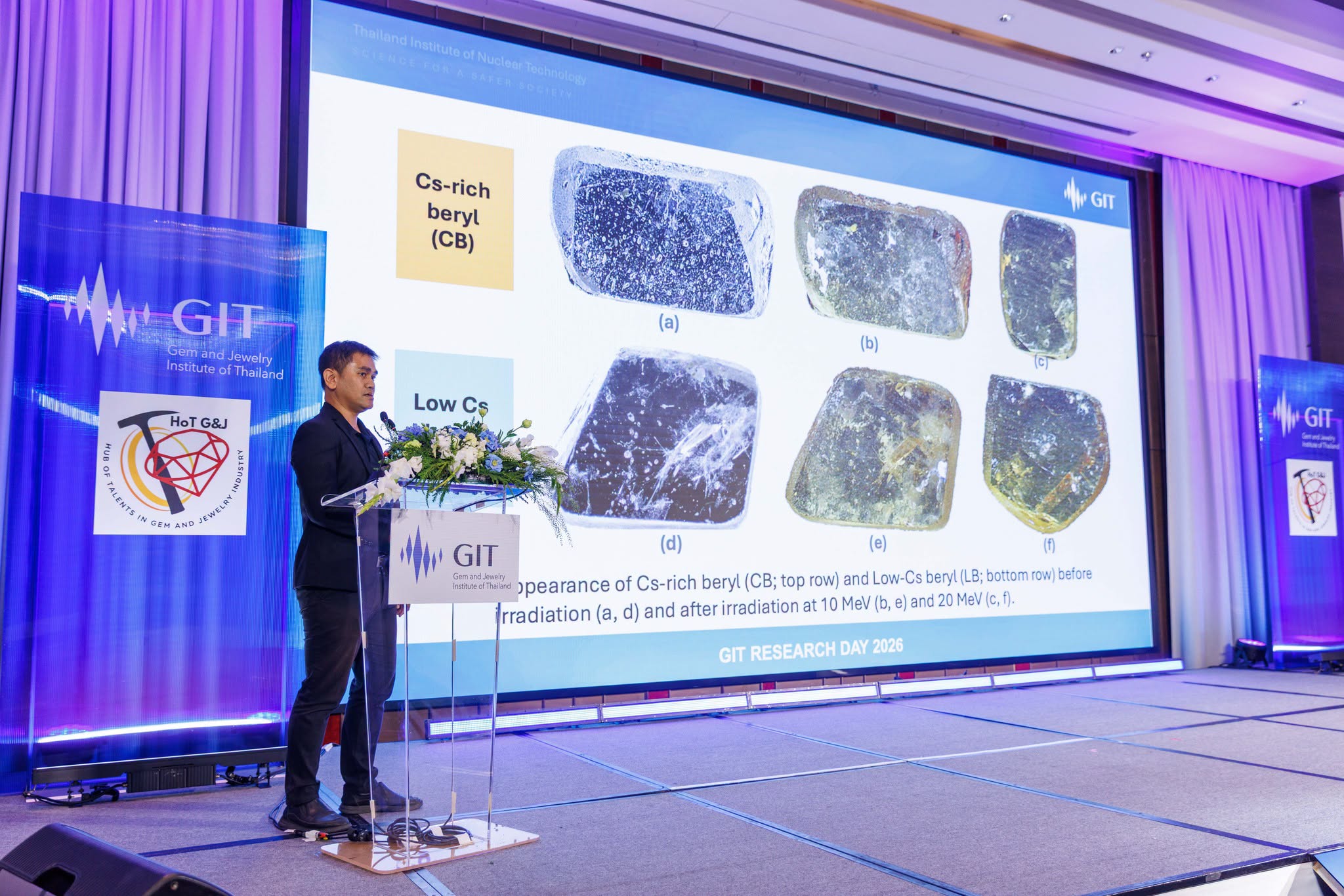
Gemports Award 2026 in Bangkok: A Night of Ruby, Sapphire and Serious Design

Vinamra Gupta
Author

[Journal]
I did not enter the Gemports Award 2026. I went to watch, which honestly is one of the better seats in the house. Our workshop sits inside the same building the finals were held in, so for us this was less "attending an event" and more "walking downstairs to see what the rest of the industry has been cooking." I wanted to write this up properly because it was one of the more interesting nights the Bangkok stone trade has put on in a while, and because I think a few of the ideas on that stage tell you where colored gemstone jewelry is going next.

The Gemports Award 2026 finals and award ceremony, held at the Event Hall inside the Jewelry Trade Center on Silom Road.
So this is our take as a Bangkok manufacturer, not an official recap. If you want the formal winner list and the association side of things, I have linked the source below and I would trust that over anyone's memory, including mine.
What the Gemports Award actually is
Quick context, because a lot of people have never heard of it and the name does not explain itself.
Gemports is an international gemstone platform that has been running since around 2019, built around making stone transactions more transparent with reports, pricing data and education. In 2025 they spun up the Gemports Award, an annual international design competition. So 2026 is only the second edition, which makes the scale of it fairly impressive.
The 2026 finals were run by the World Gems Trade Association (WGT), and this night doubled as WGT's official launch. It was co-organized by two names anyone in the Thai trade knows well, the Thai Gem and Jewelry Traders Association (TGJTA) and the Gems, Jewelry and Precious Metal Confederation of Thailand (GJPCT). There was strategic support on the China side too, with associations out of Yunnan and Guangdong involved, which matters for reasons I will get to.
The finals and award ceremony ran on Saturday, 15 August 2026, at the Event Hall inside the Jewelry Trade Center. Presiding over the ceremony were General Sonthi Boonyaratglin, a former Deputy Prime Minister, and Thapanee Kiatphaibool, Governor of the Tourism Authority of Thailand. That tells you the level this was pitched at. This was not a small design school showcase.
You can read the full brief and organizer details on the official Gemports Award 2026 page.
The Jewelry Trade Center, again
I will keep saying this until it stops being a secret. If you want to understand the Thai colored stone business, you go to Silom, and specifically to the Jewelry Trade Center. It is a whole tower of cutters, dealers, setters, labs and manufacturers stacked on top of each other, and it is where a lot of the world's ruby and sapphire quietly passes through.
The fact that WGT chose the JTC for the finals is not a coincidence. Hosting a global design competition in the building where the actual trade happens sends a message, that design and the physical stone business belong in the same room. That is exactly how we think about it too. We grow, cut and set under one roof a few floors up, so watching designers compete in the same building was, for us, very on brand.

The brief: "The Vivid Legacy"
Every year the award runs on a theme, and 2026's was "The Vivid Legacy." The short version, colored gemstones are nature's headline act, and the challenge was to take that heritage and drag it into something modern, wearable and clearly of this moment. Not costume, not museum piece, something you would actually put on.
Two rules made the whole thing more interesting than a normal design contest.
First, the stones were fixed. Every entry had to be built around ruby and/or blue sapphire as the primary gemstone. So this was not a free-for-all with every material under the sun. It was a focused study in two of the most storied colored stones there are, which is a smart constraint because it forces designers to differentiate on ideas rather than on flashy material choices.
Second, and this is the part I liked, no AI. Every piece had to be created entirely by the person, in their chosen medium, with no AI-generated elements at all. In a year when half the design world is arguing about generative tools, WGT drew a hard line and said this is a human craft competition. Agree or not, it gave the whole room a certain seriousness.
The competition was split into three disciplines and seven divisions:
2D Hand Drawing, run across Kids, Teen, Talent and Professional levels
2D Digital Drawing, at Professional level
3D CAD, at Talent and Professional levels
Awards within each division ran from Excellence down through Distinction, Merit, a Public Appreciation award decided by the crowd online, and Honorable Mentions. So there was a lot to win and a lot of people invested in the outcome.
One detail that stopped me. In the Talent and Professional drawing divisions, the ruby and sapphire in each design had to be valued using Gemports' own pricing data, within a set budget band, and that band was in the millions of USD. So designers were not just drawing pretty things. They were being asked to design around real, high-value stones at real market prices. That is a very trade way to run a design award, and I respect it.

The designs
This was the part I actually came for.
Finalist work on display.
Rather than say "the designs were beautiful" and leave it there, here is what I was actually looking at as a manufacturer.
Color pairing. With ruby and blue sapphire as the fixed palette, the strongest pieces did something considered with that red and blue relationship instead of just placing them next to each other. The clever ones used one stone as the hero and the other as a supporting accent, or played warm against cool to make the ruby read hotter.
Proportion and wearability. Because the CAD and professional entries were judged partly on whether they could actually be produced, the pieces that felt commercial were the ones you could imagine on a real hand or neck, not just on a mood board. That gap between "beautiful render" and "makeable piece" is where a lot of design competitions fall down, and this one clearly pushed against it.
Contemporary versus classic. You could split the room into two camps. One group reinterpreted heritage forms, so cleaner, more architectural takes on classic settings. The other went fully modern with sculptural, almost fashion-forward pieces. Both are valid readings of "The Vivid Legacy," and it was interesting to see which direction the judges leaned.
Hand-drawn versus CAD. Seeing the 2D hand drawing and the 3D CAD work in the same event is a good reminder that these are two different skills. A gorgeous hand rendering does not always translate to a manufacturable object, and a technically perfect CAD file is not always a beautiful idea. The best entrants had both.
The winners and finalists
Winners were announced across all seven divisions on the night. I am deliberately not going to reel off names from memory here, because getting a winner's name or category wrong in print is exactly the kind of thing that makes people stop trusting a source. For the official results, the WGT, TGJTA and Gemports channels are where I would send you, and the Gemports Award page is the cleanest starting point.
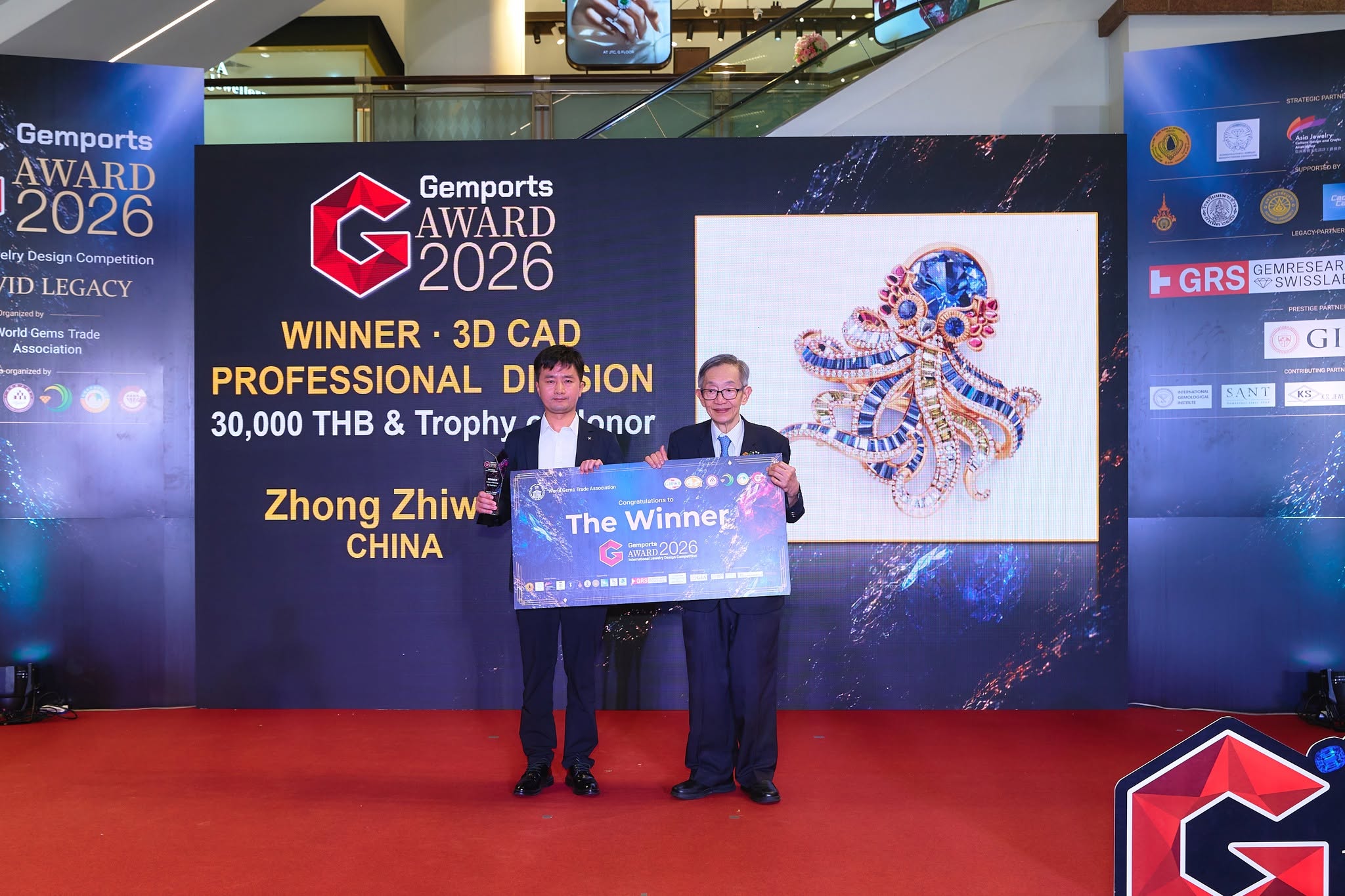
There is one thing about the winners worth flagging though. The winning and finalist works are not stopping in Bangkok. They are travelling to an exhibition in Beijing in autumn 2026, with a printed catalogue alongside. That is where the China connection I mentioned earlier pays off. The 3D CAD brief even leaned into it directly, tying the spring blossoms of Kunming, the "City of Eternal Spring," to Thailand's year-round tropical blooms as a shared cultural thread. So this was a Thai-hosted, China-facing competition by design, and for anyone thinking about where colored stone demand is going, that direction of travel is worth watching.
The jury and the experts
Two groups did the judging. An Expert Panel handled the technical side, checking eligibility, confirming the stone valuations were accurate, and making sure entries actually met the brief before anything reached the judges. Then the Jury, a set of international figures pulled from design, production, art, culture and commerce, made the final calls.
I like that structure. The expert layer keeps everyone honest on the gemstone and pricing side, which is easy to fudge in a pure design contest, and then the jury judges the actual creative merit. It mirrors how a good stone deal works in real life, verify the material first, then talk about value.
What I took away from it
A few honest reflections as someone who works with these exact stones every day.
Colored stones are having a real design moment, and ruby and sapphire are leading it. A whole competition built around just those two, at this scale, with government and tourism figures in the room, is a signal. Colored gemstones are not the sidekick to diamonds anymore.
The production-feasibility emphasis was the smartest part of the whole thing. Judging designs on whether they can actually be made drags jewelry design back toward the workshop, which is where I think it belongs. A design that cannot be set is a drawing, not a piece of jewelry.
And the human-only, no-AI rule felt like a small stand for craft in a year when everyone is automating everything. I do not think that debate is settled, but I understood why they did it.
Where lab-grown fits into all this
Here is the honest bridge back to what we do, without pretending we were part of the competition, because we were not.
Watching a design award built entirely around ruby and blue sapphire was, for us, oddly validating. Those two stones are the core of what we grow and cut in-house. When designers spend a whole competition proving how much creative range there is in ruby and blue sapphire, that is good for everyone working in colored stones, us included.
The difference is on the material side. A lot of those competition pieces were designed around natural stones valued in the millions, which is exactly why most of them will stay as designs. The version of this that a normal client can actually own is the lab-grown route, where the same rich color and clean clarity land at a price you can build a real piece around. That is the whole point of what we do. We grow and cut our own lab-grown emeralds, rubies and sapphires, and we set them alongside certified CVD diamonds, so an ambitious design does not have to stay on paper.
So if a piece from that night is living rent-free in your head and you want something in that spirit that you can actually wear, that is a conversation we love having. You can start a bespoke commission with us, or just go down a rabbit hole in our education center first. No pressure either way.

FAQ
What is the Gemports Award 2026? It is the second edition of an annual international jewelry design competition run by the World Gems Trade Association, co-organized by TGJTA and GJPCT. The 2026 theme was "The Vivid Legacy," and every entry had to be designed around ruby and/or blue sapphire.
Where and when was the Gemports Award 2026 held? The finals and award ceremony took place on Saturday, 15 August 2026, at the Event Hall inside the Jewelry Trade Center on Silom Road in Bangkok.
Who organized the Gemports Award 2026? The World Gems Trade Association (WGT) organized it, and the night also marked WGT's official launch. Co-organizers were the Thai Gem and Jewelry Traders Association (TGJTA) and the Gems, Jewelry and Precious Metal Confederation of Thailand (GJPCT), with strategic partners from China.
What were the competition categories? Three disciplines across seven divisions: 2D Hand Drawing (Kids, Teen, Talent, Professional), 2D Digital Drawing (Professional), and 3D CAD (Talent, Professional). Awards ranged from Excellence down through Distinction, Merit, a Public Appreciation award and Honorable Mentions.
Where can I see the winning designs? Winners were announced across all seven divisions at the ceremony, and the winning and finalist works are scheduled to be exhibited in Beijing in autumn 2026 with a printed catalogue. For the official winner list, check the WGT, TGJTA and Gemports channels.
Want to talk through a colored stone piece of your own? Reach out here, or read more of our notes from the Bangkok trade in the journal.