Is Lab-Grown Paraiba Tourmaline Real? The Honest Truth

Vinamra Gupta
Author
Updated
No. Tourmaline cannot be grown commercially, and that includes Paraiba. Tourmaline is one of the most chemically complex gem minerals there is, a borosilicate with a crystal structure that packs in boron, aluminium, silicon, and a long list of variable elements, and that complexity makes it extraordinarily difficult to reproduce in a lab.

[Journal]
Is Lab-Grown Paraiba Tourmaline Real? The Honest Truth, From a Jeweller Who Sells the Alternative
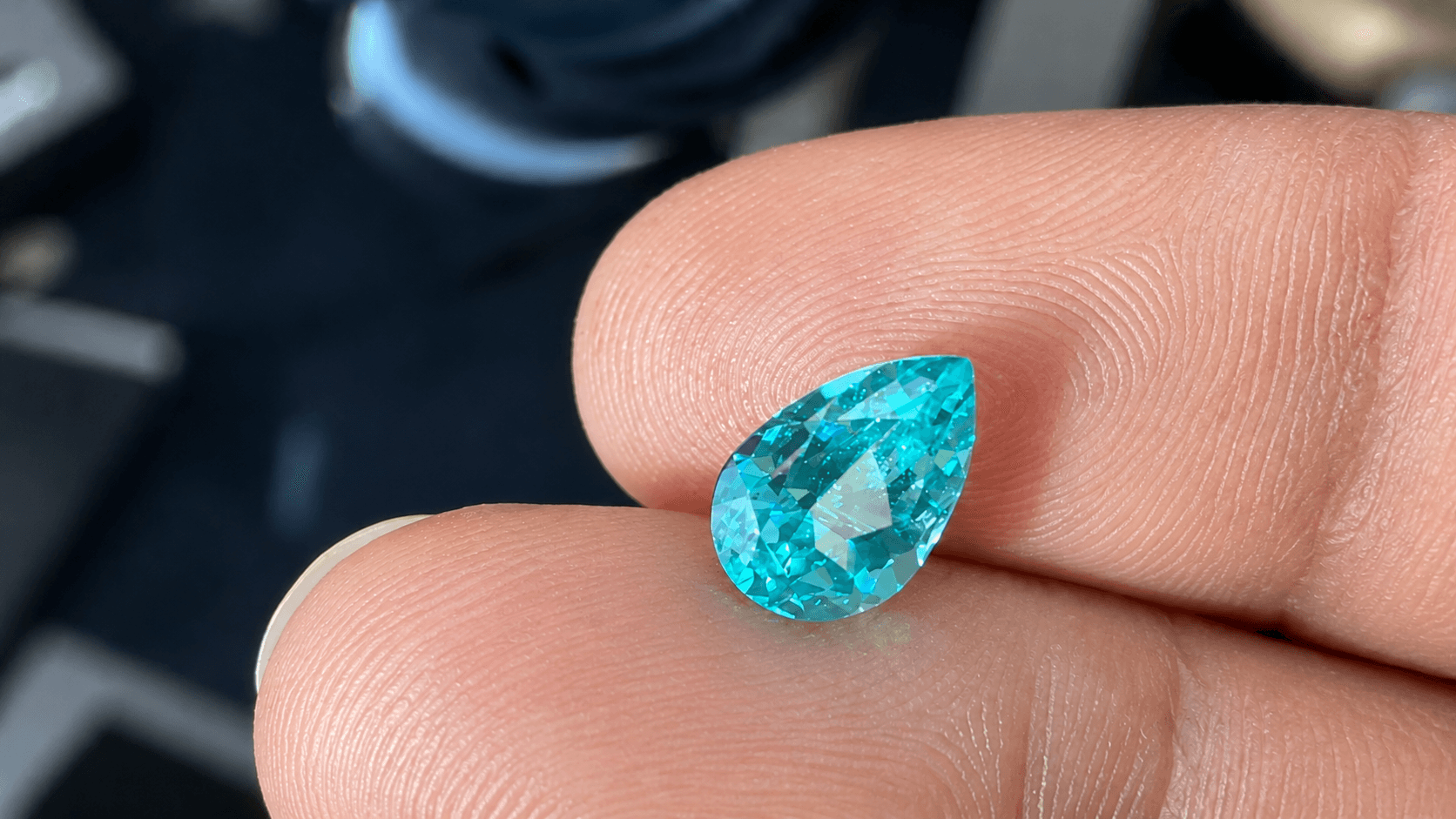
I am going to tell you something that a lot of sellers will not, including, honestly, a version of us before we knew better. Lab-grown Paraiba tourmaline does not exist. You cannot buy a real one, because nobody can grow one. If you have seen “lab-grown Paraiba tourmaline” or “synthetic Paraiba” for sale, what you are actually looking at is one of a few other things wearing that name, and you deserve to know exactly what they are before you spend money on one.
This is not me being pedantic. Paraiba is one of the most searched and most faked gem names on the internet, precisely because the real natural stone is so rare and so expensive that everyone wishes there were a cheap lab version. There isn’t, at least not as tourmaline. But there is a genuinely beautiful, genuinely honest alternative that captures the look, and it is what we make. So let me walk you through the real science first, because it matters, and then show you the honest option.
Can Tourmaline Be Lab-Grown at All?
No. Tourmaline cannot be grown commercially, and that includes Paraiba. Tourmaline is one of the most chemically complex gem minerals there is, a borosilicate with a crystal structure that packs in boron, aluminium, silicon, and a long list of variable elements, and that complexity makes it extraordinarily difficult to reproduce in a lab. The lithium-rich type that Paraiba belongs to, called elbaite, has resisted synthesis entirely.

Here is the plain version of the science. Growing a gem in a lab means getting atoms to stack into a perfect crystal under controlled heat and pressure. That works well for simple, stable structures, which is why we can grow sapphire, ruby, emerald, and diamond reliably. Tourmaline is the opposite of simple. Its structure depends on boron, which is genuinely awkward to incorporate in crystal growth, and on a delicate balance of many other elements that all have to sit in exactly the right places. Researchers have managed only tiny, experimental tourmaline crystals under extreme conditions, and the lithium-rich elbaite family that Paraiba comes from has essentially never been synthesised into anything usable. There is no factory, anywhere, producing gem-quality lab tourmaline. So when a listing says “lab-created Paraiba tourmaline,” it is not telling you the truth about the material, because that material does not exist as a product.
What Actually Makes a Paraiba a Paraiba?
A true Paraiba tourmaline gets its famous electric, almost glowing blue-to-green colour from copper, with manganese also playing a part. That copper content is the defining signature, confirmed by gem labs, and it is what separates a real Paraiba from every other blue or green tourmaline. It is also part of why the stone is so hard to imitate convincingly and impossible to grow.
This is the detail that makes the whole Paraiba story so specific. It is not just “a neon tourmaline.” It is a tourmaline coloured by copper, from a handful of deposits, originally in the Paraíba state of Brazil and later Mozambique and Nigeria. The copper-bearing chemistry is exactly the thing a lab cannot casually reproduce, because you would have to synthesise the complex tourmaline structure first and then get copper to sit in it correctly. Natural Paraiba is rare because that combination is rare in the earth, and it is costly because demand massively outstrips supply. If you want the real, mined thing, it exists and it is spectacular, and we can source it on the natural side of our business. See natural tourmaline, including Paraiba.

So What Is Being Sold as “Lab-Grown Paraiba”?
What is sold under that name falls into three very different buckets, and only one of them is a real, durable gem. There are outright simulants like YAG, glass, and cubic zirconia that imitate the colour, there is genuine lab-grown sapphire made in a Paraiba colour, and there is the real natural tourmaline. Knowing which is which is the entire point of this article.
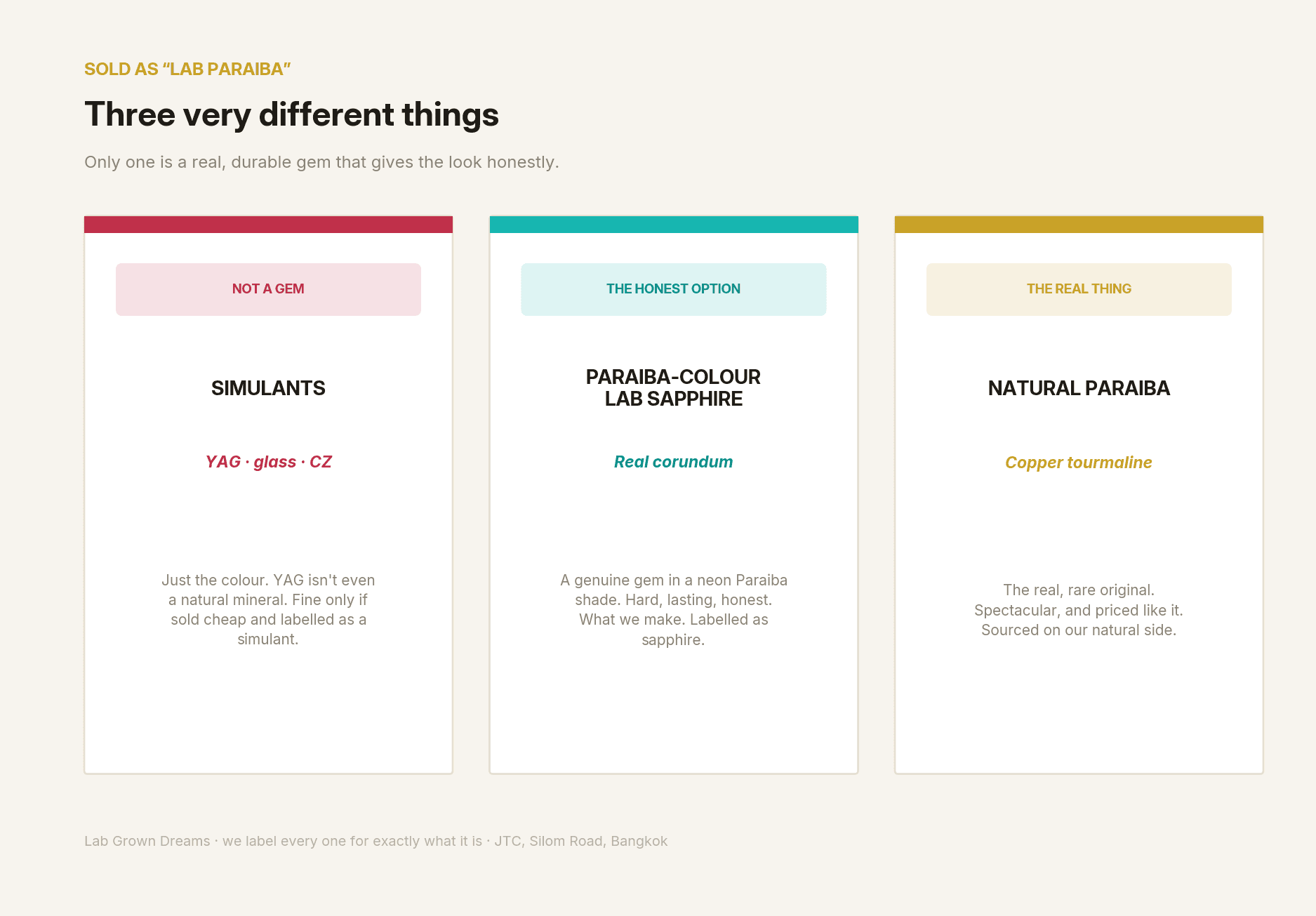
Let me take the confusing one first. YAG, short for yttrium aluminium garnet, comes up a lot in “lab Paraiba” listings. YAG is a completely man-made material that does not occur in nature at all, originally used as a diamond imitation, and it can be made in a bright neon blue-green that mimics Paraiba. It is not tourmaline, and it is not even a natural gem species, it is a simulant of the colour. The same goes for Paraiba-coloured glass and cubic zirconia: they copy the look cheaply and they are fine if, and only if, you know that is what you are buying and you pay a simulant price for them. The problem is only ever dishonesty, a simulant sold as if it were a gem. The second bucket, lab-grown sapphire in a Paraiba colour, is the honest middle path, and it is what we chose to make. And the third bucket is the real, rare, natural tourmaline itself.
The Honest Alternative: Paraiba-Colour Lab-Grown Sapphire
Because real lab Paraiba tourmaline cannot exist, we make the next best and most honest thing: lab-grown sapphire in a Paraiba colour. It is a real gem, corundum, the same mineral family as all sapphire, grown in a vivid neon blue-to-teal that captures the Paraiba look, and because it is sapphire it is actually harder and more durable than tourmaline. We label it for exactly what it is, lab-grown sapphire in a Paraiba colour, never as tourmaline.
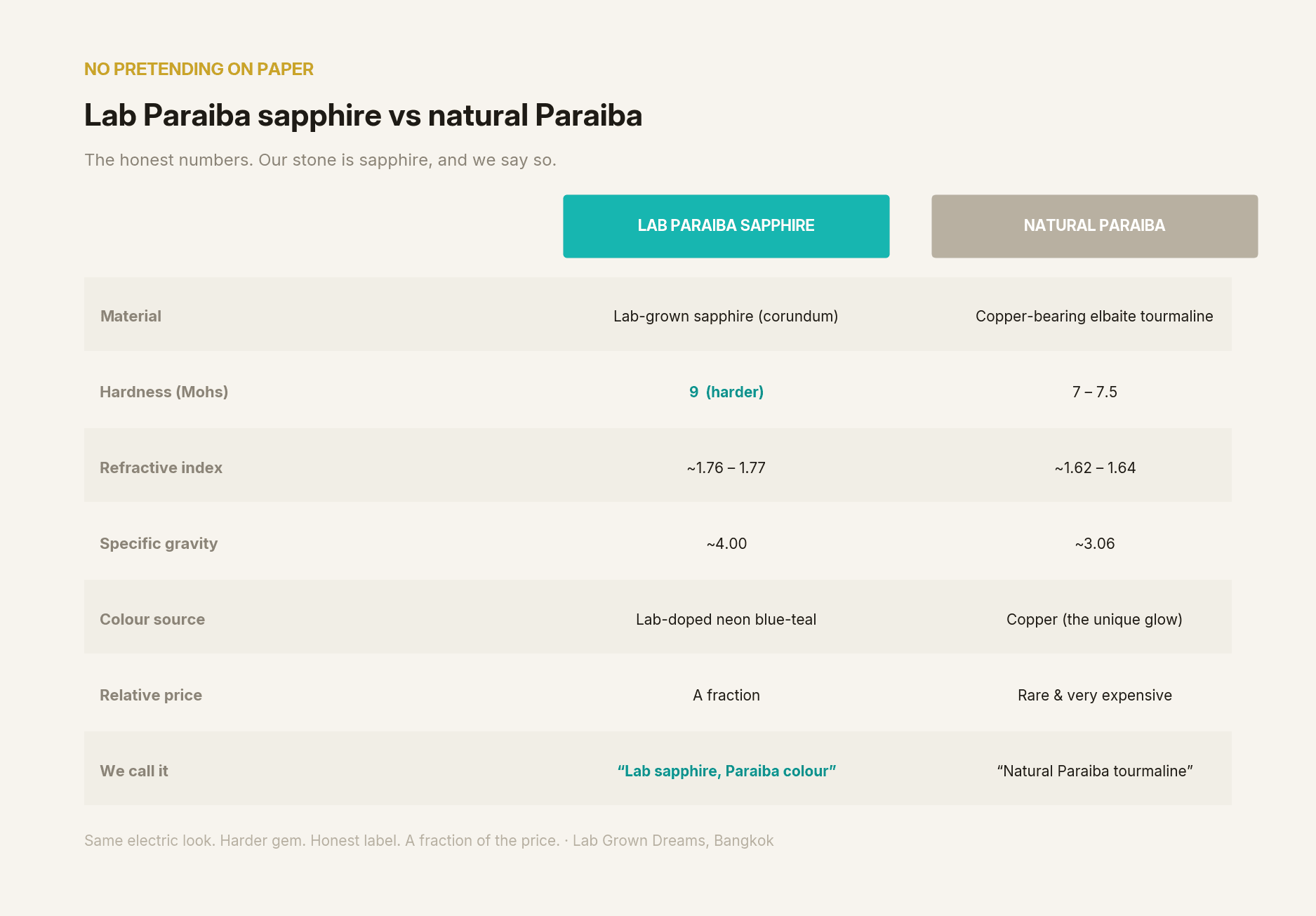
Here is the honest comparison, with the real numbers. Our Paraiba-colour stone is lab-grown corundum, which sits at 9 on the Mohs hardness scale, noticeably tougher than natural tourmaline at 7 to 7.5, which genuinely matters for a ring you wear daily. Its optical and physical properties are those of sapphire, a refractive index around 1.76 to 1.77 and a specific gravity near 4.00, where tourmaline reads around 1.62 to 1.64 and 3.06. In other words, it does not pretend to be tourmaline on paper or on an invoice, because it isn’t. What it does is deliver that unmistakable electric Paraiba glow, eye-clean and colour-stable, in a real, hard, lasting gem, at a fraction of a natural Paraiba’s price. We offer it in several shades, from electric neon to mint teal to a deeper ocean blue, cut to order. One honest caveat I will always give you: the specific glow of copper-bearing tourmaline is its own thing, and a purist can tell sapphire from tourmaline. But as a beautiful, affordable, durable way to wear that colour, it is hard to beat, and it is real. Explore Paraiba-colour lab sapphire.
Why We Tell You All of This
We tell you because the Paraiba name is abused more than almost any other in this trade, and trust is the only thing worth building a business on. It would be easier to just list “lab-grown Paraiba” and let people assume. Instead we tell you plainly that the tourmaline cannot be grown, that simulants like YAG are only the colour, and that what we sell is genuine lab sapphire in a Paraiba shade, labelled honestly.
That honesty is also just good buying advice, whoever you buy from. If a seller offers you “lab-grown Paraiba tourmaline,” you now know enough to ask the one question that matters: is this actually tourmaline, or is it sapphire, YAG, glass, or CZ in a Paraiba colour? A straight answer tells you everything about who you are dealing with. We would rather be the people who told you the truth and sold you a real, gorgeous lab sapphire than the people who sold you a word. You can read more about how lab-grown gems work in our lab-grown gemstone guide, or more on sourcing and pricing in our Paraiba journal piece.
Getting the Paraiba Look, Honestly
If you love that electric Paraiba colour, you have three honest routes and we can help with all of them: a rare, spectacular natural Paraiba tourmaline if you want the real original and the budget allows, a real lab-grown sapphire in a Paraiba colour for the look in a hard, affordable, lasting gem, or, if you genuinely just want the colour as costume, a clearly labelled simulant at a simulant price. What we will never do is blur those lines.
Tell us which route fits you and the piece you have in mind, and we will quote it straight. We cut to order, set it into custom jewellery in-house in Bangkok, certify or document the stone honestly, and ship worldwide. Design a Paraiba piece, see the lab sapphire Paraiba colours, or message us on WhatsApp and ask us anything, including to prove every claim on this page. Lab Grown Dreams by KC Gems House, Jewelry Trade Center, 919 Silom Road, Bangkok.
Frequently Asked Questions
Is lab-grown Paraiba tourmaline real? No. Lab-grown Paraiba tourmaline does not exist, because tourmaline cannot be grown commercially. Tourmaline is a chemically complex borosilicate, and its lithium-rich elbaite type, which Paraiba belongs to, has never been successfully synthesised for the gem trade. Anything sold as “lab-grown Paraiba tourmaline” is actually a simulant or a different material, not synthetic tourmaline.
Can tourmaline be lab-grown or synthesised? Not in any commercial form. Researchers have produced only tiny experimental tourmaline crystals under extreme conditions, and lithium-rich elbaite has resisted synthesis. There is no factory producing gem-quality lab-grown tourmaline of any colour, so “lab-created tourmaline” listings are simulants such as glass, YAG, or cubic zirconia.
What is YAG, and is it Paraiba? YAG, or yttrium aluminium garnet, is a fully man-made material that does not exist in nature and was originally used as a diamond imitation. It can be made in a neon blue-green that mimics Paraiba, but it is a simulant of the colour only. It is not tourmaline and not a natural gem species, and it should be sold and priced as a simulant.
What causes the colour of a real Paraiba tourmaline? The signature electric blue-to-green colour of a genuine Paraiba tourmaline is caused mainly by copper, with manganese also contributing. This copper content is the defining feature labs use to identify true Paraiba, and it is part of why the stone is so rare, so valuable, and impossible to reproduce by growing tourmaline in a lab.
What is Paraiba-colour lab-grown sapphire? It is a real lab-grown sapphire (corundum) made in a vivid neon blue-to-teal that captures the Paraiba look. It is not tourmaline and is never sold as such; it is labelled as lab-grown sapphire in a Paraiba colour. Because it is sapphire, it is harder and more durable than tourmaline, at 9 on the Mohs scale versus 7 to 7.5, and it costs a fraction of natural Paraiba.
Is Paraiba-colour lab sapphire better than natural Paraiba tourmaline? Neither is better; they are different. Natural Paraiba tourmaline is the rare, prized original with a unique copper glow and a high price. Paraiba-colour lab sapphire is a real, durable gem that gives the look affordably and lasts well in daily wear. The right choice depends on your budget and whether you want the authentic natural stone or the honest lab alternative.
How can I tell if a “lab Paraiba” is honest? Ask one question: is this actually tourmaline, and if not, exactly what material is it? An honest seller will tell you plainly whether it is lab-grown sapphire, a simulant like YAG or glass, or a natural tourmaline, and will label and price it accordingly. If a seller calls it “lab-grown Paraiba tourmaline” without qualification, treat that as a warning sign, because that material does not exist.
Keep reading: Paraiba-Colour Lab-Grown Sapphire, Wholesale from Bangkok Natural Tourmaline, Including Paraiba What Are Lab-Grown Gemstones? Design a Custom Paraiba Piece