Moissanite vs Lab-Grown Diamond for Iced-Out Jewelry: An Honest Comparison

Vinamra Gupta
Author
Updated
The real difference is simple: a lab-grown diamond is a real diamond, and moissanite is not. A lab-grown diamond is pure carbon, chemically and physically identical to a mined diamond, just created in a lab. Moissanite is a completely different mineral, silicon carbide, that happens to look similar to the eye but is its own stone with its own properties.

[Journal]
Moissanite vs Lab-Grown Diamond for Iced-Out Jewelry: An Honest Comparison
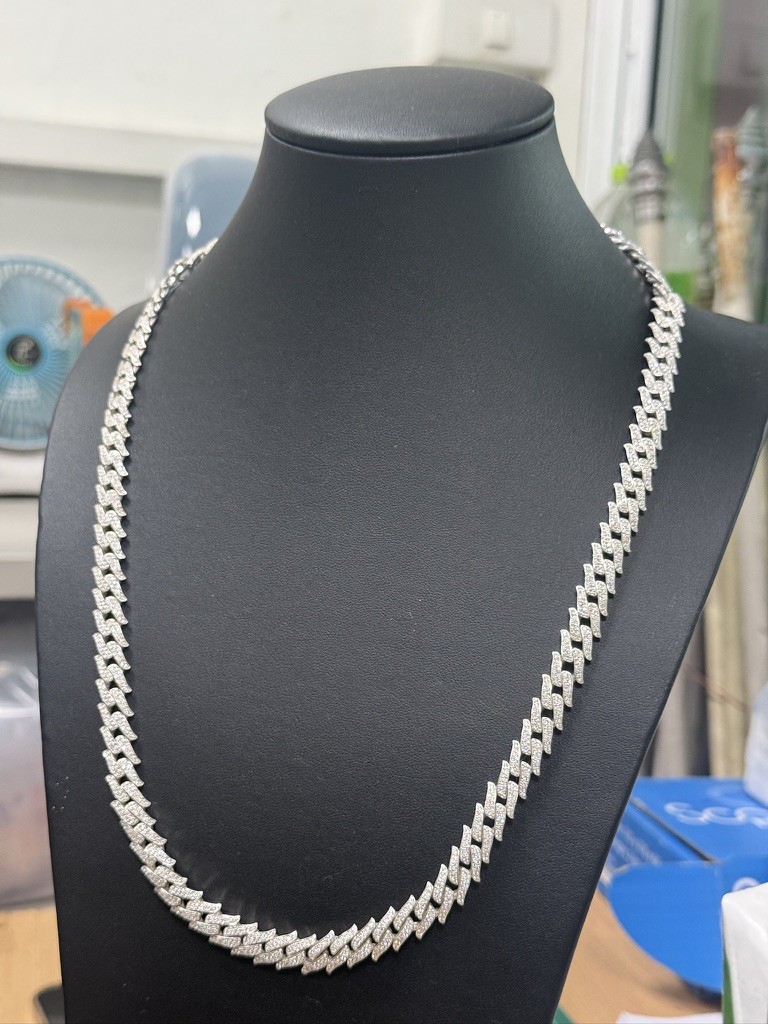
This is the question I get more than almost any other from people building an iced-out piece: should I ice it in moissanite or lab-grown diamond? And most answers you find online are useless, because they come from sellers who only offer one of the two, so of course they tell you theirs is best. We make both. I genuinely do not mind which one you pick, because we will build you a beautiful piece either way. So this is the honest version, with no spin, written to help you choose the right stone for your chain and your budget rather than the one that makes me the most money.
Here is the short answer before the detail. A lab-grown diamond is a real diamond, just grown instead of mined, and it is the choice if you want actual certified diamond ice that holds its identity and lasts a lifetime. Moissanite is a different stone entirely, not a diamond, but a brilliant and durable one that throws even more rainbow fire and costs less, making it the choice if you want maximum sparkle for the lowest spend and do not mind that it is not diamond. Both look stunning iced out. The right one depends entirely on what you actually want. Let me break it down properly.
What’s the Real Difference Between Moissanite and Lab-Grown Diamond?
The real difference is simple: a lab-grown diamond is a real diamond, and moissanite is not. A lab-grown diamond is pure carbon, chemically and physically identical to a mined diamond, just created in a lab. Moissanite is a completely different mineral, silicon carbide, that happens to look similar to the eye but is its own stone with its own properties.

That chart is the whole comparison on one page. The headline points: a lab-grown diamond is real diamond and can be certified as such by IGI or GIA, while moissanite is a diamond alternative that no lab will ever call a diamond, because it isn’t one. Both are extremely hard and perfectly suited to daily wear on a chain. Moissanite actually throws more coloured “fire” than diamond, which some people love and some find too much. And moissanite costs less, though as you will see, on a full iced piece the gap matters less than you might think. Neither is a trick or a fake, as long as it is sold honestly for what it is. The entire problem in this market is sellers passing moissanite or cubic zirconia off at diamond prices, which is the exact thing knowing this comparison protects you from.
Do Moissanite and Lab-Grown Diamond Look Different Iced Out?
Yes, there is a real visual difference, and it comes down to fire. Moissanite throws noticeably more coloured, rainbow-like flashes of light than diamond, because it disperses light more than twice as strongly. A lab-grown diamond gives a whiter, cleaner, icier sparkle. On a fully iced piece, moissanite reads as more of a disco-ball rainbow, while lab diamond reads as crisp white ice.

Here is the science behind what your eye sees, and it genuinely matters for an iced piece. Dispersion is the measure of how much a stone splits light into rainbow colours. Diamond’s dispersion is about 0.044, which gives that classic white, icy brilliance with flashes of colour. Moissanite’s is about 0.104, more than double, which is why it throws those big rainbow, almost disco flashes. On a single stone the difference is subtle. On a whole chain flooded with stones, it adds up: moissanite can look more colourful and flashy, lab diamond looks more like a clean sheet of white light. Neither is better, it is purely taste. A lot of people actually want the extra flash of moissanite for a statement chain, while others want the restrained, expensive-looking white ice that only reads as diamond. This is the single biggest reason to see both in person or on video before you decide, which we are always happy to show you.
Which Is More Durable for a Chain You’ll Wear Every Day?
Both are excellent for daily wear, but a diamond is the hardest material there is. Lab-grown diamond sits at 10 on the Mohs hardness scale, the maximum, while moissanite is about 9.25, which is still extremely hard and far tougher than almost any other gem. For a chain worn every day, both will hold up beautifully for a lifetime. The stone to avoid is cubic zirconia, at around 8 to 8.5, which dulls and scratches within a year or two.
This is where a lot of cheap “iced out” jewellery falls apart, literally. The throwaway chains flooding the market are usually CZ, and CZ is soft enough that daily wear clouds it and scratches it, so within a season or two the ice looks dead and grey. Both moissanite and lab-grown diamond are in a completely different league of durability, hard enough to stay bright and sharp for decades of real wear. So on the question of “will it last,” moissanite and lab diamond are effectively tied, and both comfortably beat the cheap option. Durability is not the deciding factor between these two. The deciding factors are the look, the price, and whether you want a real diamond.
Can People Tell Moissanite From a Diamond? Will It Pass a Tester?
Up close, a trained eye can often tell moissanite from diamond by its stronger rainbow fire and a slightly different sparkle, but across a room, on an iced chain, most people cannot tell at all. On testing, moissanite will pass a basic thermal diamond tester, because both conduct heat, but it is identified instantly by a moissanite tester, which checks electrical conductivity.
This matters for two honest reasons. First, if your goal is for the piece to simply look incredible and expensive, moissanite does that job brilliantly, and almost nobody in daily life is going to loupe your chain. Second, if anyone ever tells you a stone “passed a diamond tester, so it’s a real diamond,” do not take that as proof, because moissanite passes that basic tester too. A real diamond, lab-grown or natural, is confirmed by a proper lab report from IGI or GIA, not by a handheld pen. This is exactly why we certify our lab-grown diamond pieces: so “diamond” is a fact you can verify, not a claim you have to trust. You can read how that works in our lab diamond buying guide.
How Much Do You Actually Save With Moissanite?
Moissanite is cheaper than lab-grown diamond stone for stone, but on a full iced-out piece the saving is often smaller than people expect, because the gold is a large part of the total. On a solid gold Cuban chain, the metal itself can be a big share of the price, so switching the stones from lab diamond to moissanite lowers the cost but does not halve it.
This is the part almost no one explains, and it changes the decision. If you are buying a small piece where the stone is most of the cost, moissanite saves you a meaningful amount. But on a heavy, solid-gold iced chain, you are paying for a lot of gold no matter what you ice it with, so the gap between moissanite and lab-grown diamond narrows as a share of the whole. That often tips the decision toward lab-grown diamond for a serious piece, because for a modest percentage more you get an actual certified diamond that will always be a diamond. For a lighter or more budget-focused piece, moissanite’s saving is more significant and can be the smart call. The honest move is to get both quoted on your exact piece and see the real numbers, which we will do for you. Our lab-grown diamond price list shows the diamond side.
So Which Should You Choose for Your Iced-Out Piece?
Choose lab-grown diamond if you want a real, certified diamond that lasts a lifetime, reads as clean white ice, and will always be worth calling a diamond. Choose moissanite if you want the maximum rainbow sparkle for the lowest spend, do not mind that it is not diamond, and are building a bolder or more budget-conscious piece. There is no wrong answer, only the right one for you.
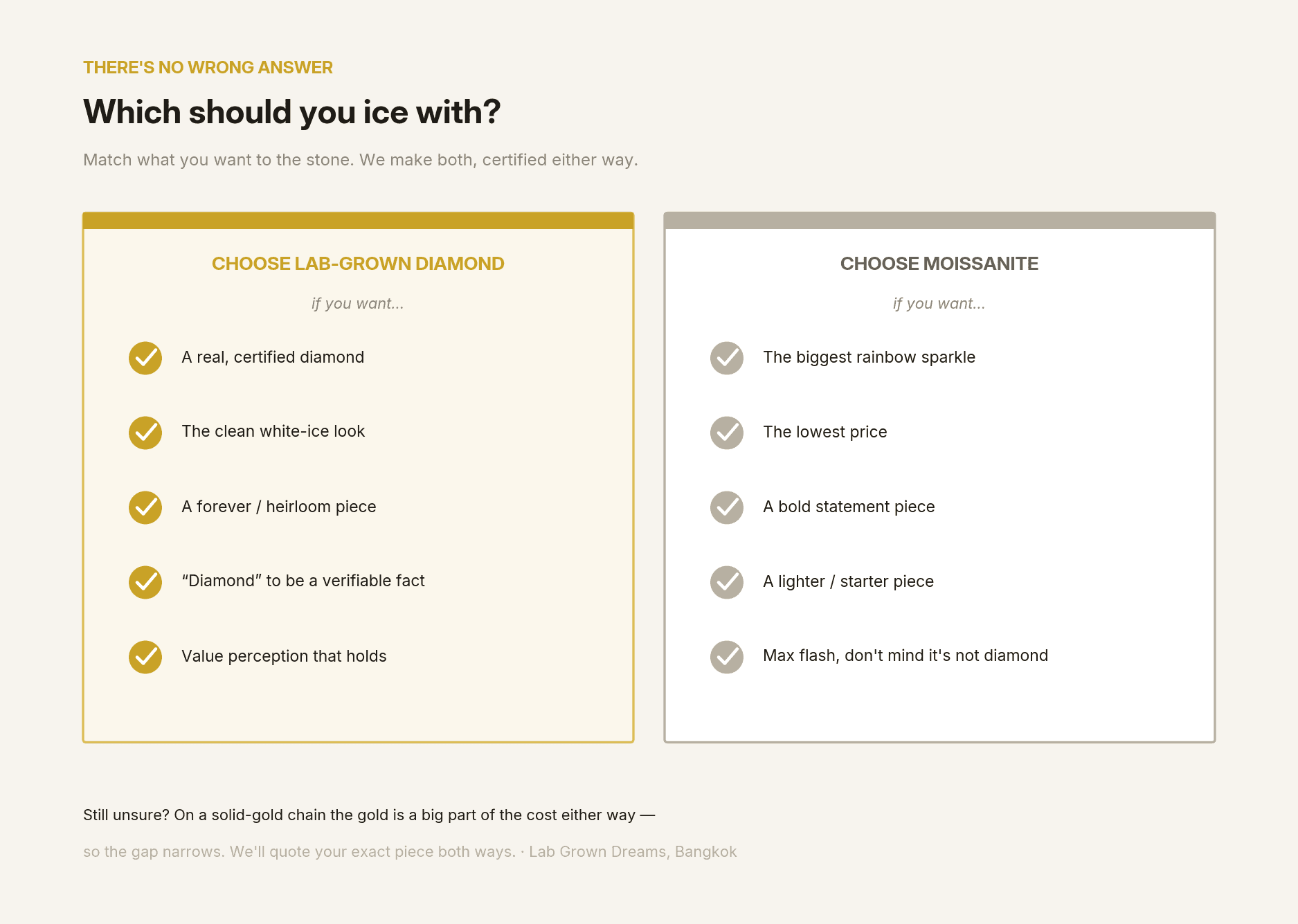
Use that chart as your decision guide. If the words “real diamond” matter to you, if you want the restrained, expensive white-ice look, or if this is a forever piece, go lab-grown diamond. If you want the biggest, flashiest rainbow sparkle, the lowest price, or a statement piece you are not precious about, moissanite is a genuinely great choice and I will never talk you out of it. And if you are still unsure, the best thing is to see both on the actual piece you are building. Because we make iced-out chains, bracelets, and custom pieces in both, we can show you your exact design in moissanite and in lab-grown diamond, with honest prices for each, before you commit a single baht. Explore the men’s collection or read the full iced-out Cuban chain guide.
How We Build It, Either Way
Whichever stone you choose, we build the piece from scratch in Bangkok at factory-direct prices, because we are the makers, not a storefront. You pick the stone, the gold, the width, and the setting, we design it in CAD so you approve the exact look before anything is made, and then we build it in-house and ship it worldwide. Lab-grown diamond pieces come certified by IGI or GIA, and moissanite pieces are built to the same standard of craftsmanship.
That is the real advantage of working with a maker directly: you are not locked into whatever one stone a retailer happens to stock. You get an honest comparison, both options priced on your actual design, and a piece made to hip-hop grade whichever way you go. Message us on WhatsApp with the piece you have in mind and your budget, and we will quote it both ways. Lab Grown Dreams, Jewelry Trade Center, 919 Silom Road, Bangkok, building iced-out jewellery in moissanite and certified lab-grown diamond for clients worldwide.
Frequently Asked Questions
Is moissanite or lab-grown diamond better for iced-out jewellery? Neither is universally better; it depends on your goal. Lab-grown diamond is a real, certified diamond with a clean white-ice look that lasts a lifetime. Moissanite is a different, more affordable stone that throws more rainbow fire. Both are very durable and look stunning iced out. Choose lab diamond for real certified diamond, moissanite for maximum sparkle at a lower price.
Is moissanite a real diamond? No. Moissanite is silicon carbide, a completely different mineral from diamond. It looks similar to the eye and is a beautiful, durable stone, but it is not a diamond and no gem lab will certify it as one. A lab-grown diamond, by contrast, is a real diamond, chemically identical to a mined one.
Can you tell the difference between moissanite and a diamond? Across a room, most people cannot tell, especially on an iced piece. Up close, a trained eye can often spot moissanite by its stronger rainbow fire. On testing, moissanite passes a basic thermal diamond tester but is identified instantly by a moissanite tester. A real diamond is confirmed by an IGI or GIA report, not by a handheld pen.
Is moissanite as hard as a diamond? Almost. Diamond is a 10 on the Mohs hardness scale, the maximum, and moissanite is about 9.25, which is still extremely hard and excellent for daily wear. Both will stay bright for decades. Cubic zirconia, at around 8 to 8.5, is much softer and dulls and scratches over time, which is why it is not suitable for a piece you want to keep.
Why does moissanite sparkle more than diamond? Moissanite has higher dispersion, about 0.104 compared with diamond’s 0.044, meaning it splits light into rainbow colours more than twice as strongly. This gives moissanite its signature extra “fire,” the big rainbow flashes, while diamond gives a whiter, icier brilliance. On a fully iced piece the difference is clearly visible, and which you prefer is purely personal taste.
How much cheaper is moissanite than lab-grown diamond? Moissanite is cheaper stone for stone, but on a full iced-out piece the saving is often smaller than expected, because the solid gold is a large part of the cost regardless of the stone. On a heavy gold chain the gap narrows as a share of the total, which often makes lab-grown diamond worth the small premium; on lighter pieces moissanite saves more. The honest way to decide is to price your exact piece both ways.
Will a moissanite chain pass a diamond tester? Yes, a basic thermal diamond tester will read moissanite as diamond, because both conduct heat. This is why “it passed a diamond tester” is not proof of a real diamond. To confirm a genuine diamond, rely on an IGI or GIA report, and to identify moissanite specifically, use a moissanite tester that checks electrical conductivity.
Keep reading: The Complete Iced-Out Cuban Chain Guide Men’s Jewellery: Cuban Chains, Bracelets and More Lab-Grown Diamond Price List, Bangkok Order a Custom Commission — Why Rappers Are Quietly Switching to Lab-Grown Iced Out Pieces — Moissanite, CVD, or Lab Diamond: What’s Actually in Your Favorite Rapper’s Chain